AI Readiness & Strategy
The AI-Augmented Workforce: Why Adaptability Is the Ultimate Currency
AI takes tasks, not whole jobs. What the 2025 evidence says about upskilling, where AI helps and hurts, and how to build an AI-augmented workforce.
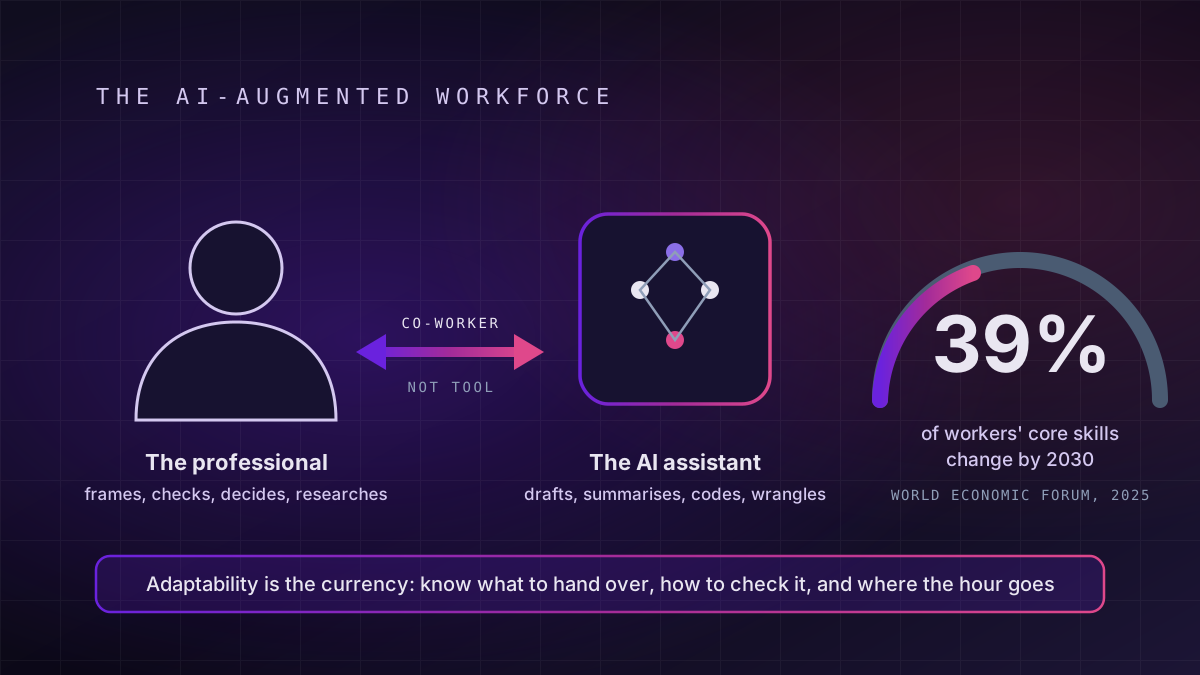
An AI-augmented workforce hands generative AI the tasks it does reliably and spends the time saved on judgement, research and harder problems. Adaptability is the currency because the World Economic Forum's Future of Jobs Report 2025 expects 39% of workers' core skills to change by 2030, and AI helps inside its frontier and misleads outside it (Dell'Acqua et al., 2023).
For most of the history of work, a professional skill meant knowing how to operate something: a lathe, a ledger, a spreadsheet, a reporting tool. You learned the tool, and the tool did what you told it. Generative AI, the class of models that produce text, code and images from an instruction, breaks that pattern. It takes an instruction, interprets it, and returns something you did not type: a draft, a summary, a working block of code, an answer that may or may not be right.
That changes what a skill is. We are no longer training people to operate tools. We are training them to work alongside a system that can do part of their job, sometimes better than they can, and sometimes confidently wrong. Microsoft and LinkedIn's 2024 Work Trend Index, a survey of 31,000 people in 31 countries, found that 75% of knowledge workers already use AI at work, and that 78% of them bring their own tools rather than wait for the company to provide one.
Failure mode
The gap is already open
In Microsoft and LinkedIn's 2024 Work Trend Index, two-thirds of leaders said they would not hire someone without AI skills, while only 39% of AI users had received any AI training from their employer. People are learning in the dark, on tools nobody chose.
The usual response is a fear story: AI is coming for the jobs. The evidence so far points somewhere more useful. AI is taking tasks, not whole jobs, and the people who do best with it are the ones who know which tasks to hand over, how to check the result, and what to do with the hours they get back. This article sets out what that looks like in practice, where it goes wrong, and what a leadership team should do about it in the next two quarters.
What an AI-Augmented Workforce Actually Means
The phrase gets used loosely. It is applied to any team that has a chatbot licence, and to automation programmes that quietly remove roles under a friendlier name. Neither is what the term means.
An AI-augmented workforce is one in which generative AI performs a defined share of each role's tasks, people stay accountable for the outcome, and the time released is deliberately redirected to work the AI cannot do: framing the problem, checking the answer, deciding, and researching the next harder question. The word that matters is deliberately. Augmentation that happens by accident, one person at a time, with no change to what the role is for, is not a workforce strategy. It is unmanaged drift.
Three things follow from that definition. The unit of change is the task, not the job, so you have to know which tasks a role contains. Accountability does not move, so every role needs the skill of checking AI output as well as producing it. And the productivity gain is only a gain if it is reinvested; otherwise it is absorbed into the same inbox at the same pace. We describe the first two as the two fluencies, and the third as the time shift, and the rest of this article is about all three. Together they are what adaptability means for a professional now: the ability to re-sort your own work, task by task, as the frontier of what AI does reliably moves.
What the Evidence Says About AI and Jobs
What this means for you: the serious studies agree on direction, so the question for your organisation is no longer whether to augment work with AI but how to do it without losing the judgement that makes the output trustworthy.
The headline numbers are better than the headlines. The World Economic Forum's Future of Jobs Report 2025, based on more than 1,000 employers representing over 14 million workers across 55 economies, expects 170 million jobs to be created and 92 million displaced by 2030, a net gain of 78 million. The same report expects 39% of workers' core skills to change in that period, and estimates that 59 of every 100 workers will need training by 2030: 29 upskilled in their current role, 19 reskilled and moved to a new one, and 11 who need it but are unlikely to get it.
The field experiments say the gains are real and uneven. Brynjolfsson, Li and Raymond's study of 5,179 customer support agents, published as an NBER working paper in 2023 and in the Quarterly Journal of Economics in 2025, found that access to a generative AI assistant raised issues resolved per hour by 14% on average, and by 34% for novice and low-skilled workers, with minimal effect on the most experienced. The AI, in effect, spread the habits of the best agents to the newest ones.
| Source | Year | What it measured | Finding | What we take from it |
|---|---|---|---|---|
| World Economic Forum, Future of Jobs Report | 2025 | 1,000+ employers, 14 million workers, 55 economies | 170m jobs created, 92m displaced by 2030; 39% of core skills change; 59 in 100 workers need training | Budget for training every role, not a pilot group |
| Brynjolfsson, Li and Raymond, National Bureau of Economic Research (NBER) / QJE | 2023 / 2025 | 5,179 customer support agents, staggered AI rollout | 14% more issues resolved per hour; 34% for novices; little change for experts | Point AI at onboarding and the long tail of newer staff first |
| Dell'Acqua et al., Harvard Business School and BCG | 2023 | 758 consultants, 18 realistic tasks | 12.2% more tasks, 25.1% faster, higher quality inside AI's frontier; 19 percentage points less likely to be correct on a task outside it | Map which of your tasks sit inside the frontier before you delegate |
| Microsoft and LinkedIn, Work Trend Index | 2024 | 31,000 people, 31 countries | 75% of knowledge workers use AI; 78% bring their own tools; 39% have had employer training | Replace shadow AI (tools staff adopt unapproved) with sanctioned tools and training |
| Anthropic Economic Index | 2025 | About one million real Claude conversations | 57% of use augments a person's work, 43% automates a task; 36% of occupations use AI in at least a quarter of their tasks | Expect collaboration, not replacement, to be the dominant pattern |
| PwC, Global AI Jobs Barometer | 2025 | Close to a billion job adverts, company financials | 56% wage premium for AI skills, up from 25%; skills changing 66% faster in AI-exposed occupations | Treat AI fluency as a pay-grade skill, and plan for faster skill churn |
The usage data points the same way. Anthropic's Economic Index, published in February 2025 from about one million Claude.ai conversations, classified 57% of AI use as augmentation, where the person and the model iterate together, and 43% as automation, where the model completes the task with minimal human involvement. Collaboration, not substitution, was the dominant pattern in that usage data.
So far AI is taking tasks, not whole jobs. The job is becoming the part that decides what the tasks are for.
And the labour market is already pricing it. PwC's 2025 Global AI Jobs Barometer, drawing on close to a billion job adverts, found a 56% wage premium for roles requiring AI skills, up from 25% the year before. The premium is partly scarcity, as PwC itself notes. But scarcity is the point: the people who can work with these systems are in short supply, and the gap is widening faster than training budgets are moving.
Where AI Helps and Where It Hurts: The Jagged Frontier
What this means for you: the same tool that makes a team faster on one task makes it confidently wrong on the next, and nothing about the task's apparent difficulty tells you which is which.
The most important single study for anyone planning an AI-augmented workforce is Dell'Acqua and colleagues' 2023 field experiment with 758 Boston Consulting Group consultants, published as Harvard Business School Working Paper 24-013. On 18 realistic consulting tasks that sat inside what the authors call the jagged technological frontier of AI capability, consultants with GPT-4 completed 12.2% more tasks, finished them 25.1% faster, and produced work of significantly higher quality.
Then the authors gave the same consultants a task chosen to sit just outside that frontier: a management decision that needed a careful read of interview notes and financial data together. Consultants using AI were 19 percentage points less likely to reach the correct recommendation than those without it. They were faster, more confident, and more often wrong.
Why the frontier is jagged, not a line
The frontier is jagged because AI capability does not track human difficulty. A task that feels hard to a person, such as drafting a strategy memo from a brief, can sit comfortably inside the frontier. A task that feels routine, such as reconciling two sources that quietly disagree, can sit outside it, because the model fills the gap with something plausible rather than flagging it.
That is why "use your judgement about when to use AI" is not a policy. Judgement about the frontier has to be built, task by task, from evidence, and then taught. The consultants in the BCG study were not careless people. They were experienced professionals who trusted a fluent answer, which is precisely what fluent answers are designed to earn.

The delegation test
In our engagements we sort tasks with three questions before anyone is told to hand them to an AI. We call it the delegation test, and it is deliberately simple enough to run on a whiteboard.
- Is the task inside the frontier? Has this kind of task been tried, on your data, with the output checked by someone qualified, and did it hold up? A guess is a no.
- Can the person check the output? Is there an independent source, a test, a reference figure or a second reader that would catch a plausible wrong answer? If the only check is "it reads well", it is a no.
- Where does the saved time go? Is there a named, harder piece of work waiting for the hours released? If the answer is "more of the same, faster", the gain will evaporate.
Readiness signal
You have found the frontier when
For each task a role performs, you can say from evidence, not instinct, whether AI output on it has been checked and held up. A task you cannot say that about is outside the frontier until you can.
A task that passes all three is delegated with a checking step. A task that fails the first stays with the person. A task that fails the second gets a check designed before it is delegated, which is often the most valuable work in the whole programme. The next section is about what the people do with the time.
The Two Fluencies Every Professional Needs Now
What this means for you: AI fluency without sharper judgement produces fast, confident errors; judgement without AI fluency leaves the gains on the table, and both have to be taught to everyone, not to a centre of excellence.
The skill that is now mandatory is not prompt engineering. Prompting is a mechanical layer that changes with every model release. The durable skill is knowing what to ask a system to do, recognising when its answer is wrong, and deciding what to do instead. We describe this as two fluencies, and every role in the organisation needs a working level of both.
AI fluency
Knowing what current models do reliably, how to give them context, and how to iterate with them rather than accept the first answer. It is a general skill, like spreadsheet literacy became, not a specialist one.
Judgement fluency
Knowing how to check an output against something independent, when a fluent answer is hiding a gap, and which decisions stay with a person whatever the model says. This is the half most training programmes skip.
The time shift
The third requirement alongside the two fluencies: deliberately moving the hours AI releases into research, problem framing and the harder questions that were never reached. Without this, the gain is absorbed and nothing changes.
AI fluency: the collaborator, not the tool
The Brynjolfsson, Li and Raymond result is the clearest picture of what AI fluency does at scale. The assistant in their study did not replace agents. It watched the best ones and suggested their habits to the rest, and novices improved by 34% while experts barely moved. That is what a collaborator does: it carries the accumulated practice of the organisation to whoever needs it next.
In practice, AI fluency means a professional can describe a task well enough for a model to attempt it, supply the context the model lacks, recognise the difference between a first draft and a finished answer, and keep iterating. It also means knowing the tools the organisation has sanctioned, which is why the choice of first generative AI use cases matters so much: people learn fluency on the tools in front of them.
Judgement fluency: the amplified human
The second fluency is the one that separates the BCG consultants who were helped from the ones who were misled. Judgement fluency is the trained habit of asking where an answer came from, what would be true if it were wrong, and what independent evidence would settle it. The World Economic Forum's 2025 report ranks analytical thinking as the core skill employers value most, ahead of any technical skill. In our experience that ranking is exactly right.
The model makes the first draft cheap. That makes the person who can tell a good draft from a wrong one expensive.
This is also the fluency that regulation now assumes. Article 4 of the EU AI Act, the AI literacy obligation in the EU's regulation on AI systems (Regulation (EU) 2024/1689), has applied since 2 February 2025. It requires providers and deployers to take measures to ensure, to their best extent, a sufficient level of AI literacy among the staff who operate or use AI systems, taking account of the context in which the systems are used. In the UK, Articles 22A to 22D of UK GDPR, in force since 5 February 2026, set the safeguards for decisions based solely on automated processing that have legal or similarly significant effects, including the right to human intervention. Both assume a workforce that can tell when a system has reached the edge of what it should decide. The engineering view of AI governance and the people view in this article are the same control seen from two sides.
The time shift: where the hours go
AI does not make an organisation better by itself. It makes time. What the organisation does with the time is the strategy. In our experience the teams that benefit are the ones that name, in advance, the work that has been waiting: the root-cause analysis nobody had a week for, the data quality problem everyone works around, the customer question that keeps coming back and never gets researched. Those are the bigger problems, and they are the reason to take the routine work off people in the first place.

The time shift is also where the sequencing of a data and AI roadmap and the sequencing of a workforce programme meet. The hours released in the first quarter should go to the data foundation work that the second quarter's use cases depend on. A workforce programme that is not tied to a delivery roadmap produces trained people with nothing changed to work on.
Why Upskilling Is an Enterprise Mandate, Not a Perk
What this means for you: the cost of not training is already being paid, in shadow tools, in unchecked output and in a wage premium you will meet at the next hiring round.
The Microsoft and LinkedIn numbers describe an organisation that has already adopted AI without deciding to. Three-quarters of knowledge workers use it. More than three-quarters of those bring their own tools. Fewer than four in ten have been trained by their employer. That is not a future risk; it is the present state of most enterprises we meet, and in our engagements it means confidential data is reaching consumer tools and unchecked output is reaching decisions, with no record of either.
The World Economic Forum's estimate that 59 in 100 workers need training by 2030 is the scale of the task. Its breakdown is the plan: 29 upskilled in their current role, 19 reskilled and moved, and 11 who need training and are unlikely to receive it. That last group is the one a leadership team can change. Universal upskilling means every role, including the ones that look furthest from AI, because the frontier reaches them too.
Key idea
Training is a control, not a benefit
An AI literacy programme is the control that makes every other AI control work. A policy on checking output, a rule about which tools are sanctioned, a human-in-the-loop requirement: each one assumes people who know what to look for. Fund it as governance, not as learning and development.
There is a cost argument as well as a risk argument. PwC's 56% wage premium for AI skills is what you pay to hire fluency from outside. Teaching it inside is cheaper, keeps the domain knowledge the organisation already has, and, on the Brynjolfsson, Li and Raymond evidence, lifts the people with the most room to grow by the most. The same study found that AI-assisted agents stayed in their jobs longer, which is a retention effect no training budget line usually gets credit for.
The organisations getting this right treat it the way they treat security awareness: everyone, every year, tied to the tools and tasks people actually have, with the judgement half given as much time as the mechanics. The operating model for governing generative AI names the roles that own this; the training is how those roles reach everyone else.
When Augmentation Is the Wrong Answer
What this means for you: some tasks should be automated outright with a downstream check, some should be left to people, and treating everything as a collaboration wastes the first and endangers the second.
Augmentation is the dominant pattern, not the universal one. Within Anthropic's 43% automation share there is real work where, in our experience, a person adds nothing by being in the loop: reformatting, classification at volume, first-pass extraction from documents with a downstream check. Insisting on a human for each of those is cost without control. Those tasks belong in agentic systems with the approval steps designed in, and the point at which an agent is trusted to act is a separate decision from how you augment a professional.
At the other end, some decisions should not be augmented at all until the frontier moves. The BCG study's outside-frontier task is the template: a decision that depends on reconciling sources that disagree, where a plausible synthesis is worse than no synthesis. Decisions with legal or similarly significant effects on individuals sit here by law, under UK GDPR Articles 22A to 22D, as well as by prudence. Here the right use of AI is to prepare the evidence, not to recommend the answer.
In practice
In practice: start with the tasks nobody will miss
When a team is anxious about AI, we start the delegation test with the tasks they most resent: the weekly summary, the status report, the reformatting. The first gain lands on work nobody wanted, the checking habit is learned where the stakes are low, and the conversation about harder tasks happens with people who have already seen the tool be wrong.
And augmentation is the wrong first move when the data underneath is not trustworthy. A model summarising reports built on inconsistent definitions will produce fluent summaries of inconsistent numbers. The data governance that makes the numbers agree is a prerequisite, which is why we argue that a transformation that works fixes the data foundation first, and why the first quarter of an AI workforce programme often looks like a data programme.
What to Do in the Next Two Quarters
What this means for you: a workforce programme that produces trained people and a changed set of tasks in six months beats a three-year academy plan that produces a curriculum.
Start with one team and one week. List the tasks the team actually performs, in the words they use, and run the delegation test on each. In our engagements this takes a day and produces three lists: tasks AI can take now with a check, tasks that need a check designed first, and tasks that stay with people. The third list is usually shorter than the team expected, and the second is where the interesting work is.
Then make the time shift explicit. For every hour the first list releases, name the work it funds: a backlog item, a research question, a data quality fix. Write it down. A gain without a destination is absorbed within a month, and the team concludes, correctly, that nothing changed.
Sort and sanction
Run the delegation test on one team. Replace the shadow tools with sanctioned ones. Train the two fluencies on the tasks that team actually has, with the judgement half given equal time.
Design the checks
For every delegated task, define the independent check: a test, a reference figure, a second reader. Record who signs off. This is the control the regulators and your auditors will ask to see.
Shift the time
Direct the released hours at the named harder problems, starting with the data foundation the next use cases depend on. Measure what got researched and fixed, not hours saved.
Extend by evidence
Take what held up to the next team. Promote tasks across the frontier only when their checked output has earned it. Log the ones that failed, because the frontier moves and you will revisit them.
Timing with scope attached: one team sorted, sanctioned and trained on the two fluencies is weeks of work, not quarters. Extending it across a function, with checks designed and a delivery roadmap to absorb the released time, is the multi-quarter work, and it should run alongside the AI readiness assessment that decides which use cases the organisation funds next.
The organisations that come through this well will not be the ones with the most AI licences. They will be the ones whose people can tell, task by task, what to hand over, how to check it, and what harder problem to spend the afternoon on instead. That is what adaptability means in practice, and it is why it has become the currency. If you want help running the first sort, our digital transformation and agentic AI teams do it as the opening week of an engagement, and the output is the three lists above with the checks designed.
Frequently Asked Questions
What is an AI-augmented workforce?
An AI-augmented workforce is one in which generative AI performs a defined share of each role's tasks, people stay accountable for the outcome, and the time released is deliberately redirected to judgement, research and harder problems. The unit of change is the task, not the job. Anthropic's 2025 Economic Index classified 57% of the AI use it observed as augmentation and 43% as automation, where the model completes the task with minimal human involvement.
Will AI take my job or make me more productive?
The evidence to date points to tasks moving, not whole jobs disappearing. The World Economic Forum's 2025 Future of Jobs Report expects 170 million jobs created and 92 million displaced by 2030, a net gain of 78 million. Brynjolfsson, Li and Raymond's 2023 study of 5,179 support agents found an AI assistant raised productivity 14% on average and 34% for novices. In our experience the gains go to people who know what to delegate and how to check it.
What skills do professionals need to work with AI?
Two fluencies. AI fluency is knowing what current models do reliably, how to give them context and how to iterate rather than accept a first answer. Judgement fluency is knowing how to check an output against an independent source, when a fluent answer hides a gap, and which decisions stay with a person. The World Economic Forum's 2025 report ranks analytical thinking as the skill employers value most, ahead of any technical skill.
Why does AI make some work worse rather than better?
Because AI capability has what Dell'Acqua and colleagues call a jagged technological frontier: it does not follow human difficulty. In their 2023 experiment with 758 BCG consultants, AI users completed 12.2% more tasks 25.1% faster inside the frontier, but were 19 percentage points less likely to be correct on a management decision just outside it. The model fills gaps with plausible text rather than flagging them, so tasks that reconcile disagreeing sources need a person or an independent check.
Is AI literacy training a legal requirement?
In the EU, in effect yes for organisations in scope. Article 4 of the EU AI Act, applicable since 2 February 2025, requires providers and deployers to take measures to ensure, to their best extent, a sufficient level of AI literacy among staff who use AI systems. The UK has no equivalent duty, but UK GDPR Articles 22A to 22D, in force since 5 February 2026, require safeguards, including human intervention, for solely automated decisions with significant effects.
Unolabs is a Data and AI first engineering consultancy, headquartered in the United Kingdom with engineering operations in Pune and active engagements across the UK, Australia, and Hong Kong. We help enterprises build the architectural foundation for autonomous AI execution — governed data platforms, semantic intelligence, and agentic systems that enterprises can stand behind.
If you are weighing how to prepare your teams to work alongside AI rather than around it, book a discovery call and we will work through it with you.
More Where
This Came From.
New architectural deep-dives land every two weeks. Pick your channels and we will send them as they publish.
Continue reading
- AI Readiness & StrategyEnterprise Generative AI Use Cases That Reach Production, Grouped by What Each One NeedsEnterprise generative AI use cases grouped by what each needs to reach production, where each one fails, and its likely EU AI Act risk tier.17 min read
- Data Governance Trends 2026The EU AI Act and Your GenAI Operating Model: A Compliance-Ready BlueprintWhat the EU AI Act asks of GenAI deployers, and the operating model that satisfies it: named roles, four lifecycle gates, and evidence at each step.14 min read
- Data Platform StrategyDo 70% of Digital Transformations Really Fail?No reliable study shows 70% of digital transformations fail. What BCG (2020) and McKinsey (2018) actually measured, and the six-month test to apply.13 min read
Find out where your teams should delegate first
Bring one team's week of work. We will sort its tasks with the delegation test, show which ones AI can take today, and where the time saved should go so the people, not only the tools, get more capable.
Book a Workforce AI Review