Risk & Compliance
AI Ethics Isn't a Policy Document. It's Whether the Client Still Owns Their System When You Leave.
AI ethics is decided less by charters than by control. Three plain questions show whether a client still owns the AI system once the vendor leaves.
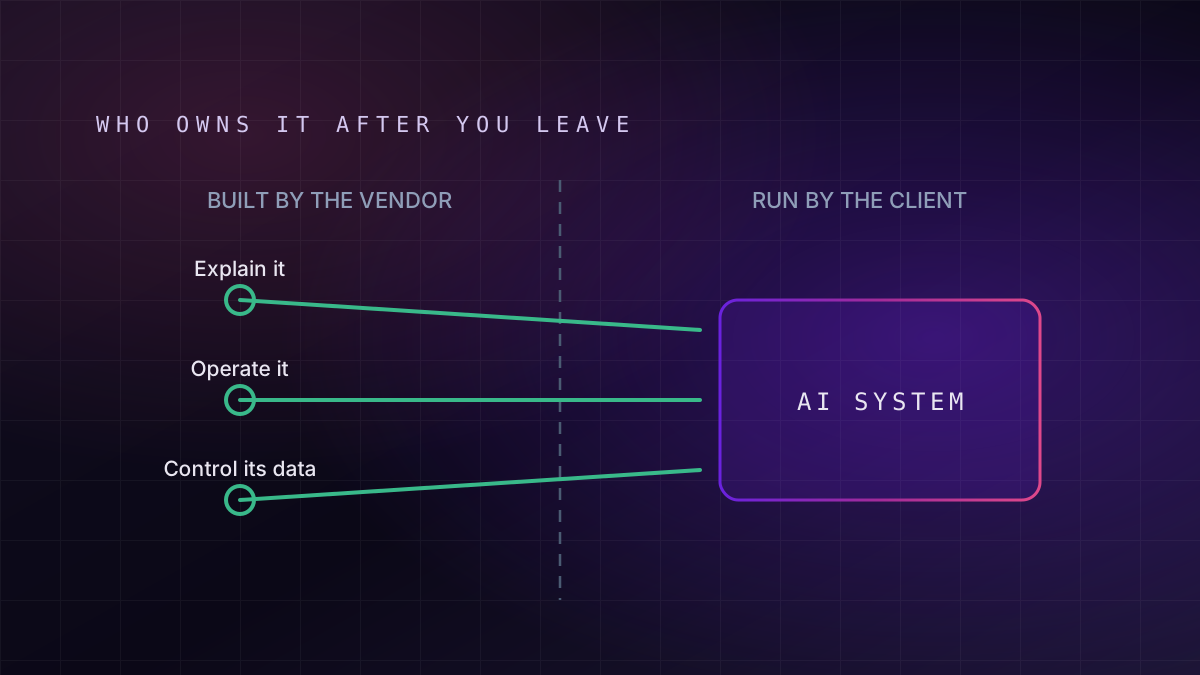
An AI deployment is ethical in practice only if the client still controls it once the builder leaves. That turns on three things: whether the client can explain why the system decides as it does, whether they can operate and change it without the original vendor, and whether they decide who reaches the data powering it.
Most AI ethics conversations in enterprise consulting stay abstract. Bias mitigation frameworks, responsible AI charters, ethics committees that meet quarterly and produce a PDF nobody reads. Useful in theory. Rarely the thing that actually determines whether an AI deployment was ethical in practice.
The gap is measurable. The World Economic Forum's responsible AI playbook, published with Accenture in September 2025, found that fewer than 1% of organisations had fully operationalised responsible AI in a comprehensive and anticipatory way. Principles are common. Principles that change what a system actually does are rare.
Key idea
Ethics is a property of control, not of documentation
A charter describes what an organisation intends. Whether an AI system behaves ethically over its working life depends on who can see inside it, change it and switch it off — and that is decided by architecture and contract, usually long before anyone writes the charter.
The more honest question is simpler, and far less comfortable for most of the industry to answer.
Who Actually Controls the System Once It Is Built
What this means for you: before asking whether a system is biased, ask whether you could find out — and fix it — without the people who built it.
An AI system trained on a client's data, deployed inside their operations, making decisions that affect their customers or employees, raises an ethics question before it raises a bias question: does the client own and control that system, or are they dependent on the vendor who built it?
Vendor lock-in is not just a commercial inconvenience. When a client cannot audit, modify, or walk away from an AI system without the original vendor's involvement, they have lost meaningful oversight of something making consequential decisions inside their business.
That is an ethics gap disguised as a business model.
The scale of that dependence is not hypothetical. Zapier's 2026 survey of 542 US executives at organisations paying for AI vendors found 47% saying that losing their primary vendor would disrupt key business functions, and 27% describing themselves as completely reliant. Those are commercial findings. Read them as oversight findings and they say something sharper: a large share of AI in production is being run by organisations that could not take it back if they had to.
| Ethics as a charter | Ethics as control | |
|---|---|---|
| Where it lives | A policy document and a committee calendar | The system's architecture, its contracts and its access model |
| When it acts | After something has gone wrong | Before deployment, and at every change |
| Who holds it | Often the vendor's process, described to the client | The client, in a form they can exercise alone |
| What it proves | That someone considered the risk | That the client can see, change and stop the system |
| What it costs you | Very little — which is the problem | Design effort up front and a harder vendor negotiation |
Why Lock-In Makes Oversight Impossible to Discharge
What this means for you: the regulation already assumes the client can oversee its own AI, and lock-in quietly makes that assumption false.
Under the EU AI Act, the organisation using a high-risk system is its deployer, and Article 26 requires it to assign human oversight to people with the competence, training and authority to exercise it. Those duties apply to stand-alone Annex III systems from 2 December 2027, after the 2026 amendment deferred them from August. The detail of what the Act asks of deployers is set out elsewhere; the point here is narrower.
Oversight is a capability, not a job title. A person cannot meaningfully oversee a system whose logic they cannot inspect, whose behaviour they cannot change, and whose operation stops the day a contract ends. Naming an oversight owner inside a locked-in deployment satisfies the wording of the duty while making it impossible to perform.
UK organisations are not outside this. Since 5 February 2026, Articles 22A to 22D of the UK GDPR have permitted significant automated decisions only with safeguards — including the ability for the person affected to obtain human intervention and contest the outcome. A controller that cannot reach inside its own system cannot reliably provide either.
Failure mode
The duty sits with the client, not the vendor
When an AI system produces a harmful or unlawful decision, the organisation that put it in front of customers or staff answers for it first. A contract that leaves the means of oversight with the vendor does not move that accountability. It only removes the client's ability to act on it.
The same logic applies to agents, where the question of who signs off when an agent acts only has an honest answer if the person signing can also stop it.
Data Residency Is an Ethics Decision, Not Only a Compliance One
What this means for you: where your data sits, and who can reach it, decides whether you are informed about your own AI system or relying on someone else's account of it.
Where a client's data physically sits, and who can access it, gets treated as a checkbox for regulatory compliance. It is also, quietly, one of the clearest ethical commitments a firm can make.
Data residency within a client's own environment means the client, not the vendor, decides who sees their data and how it is used.
It's the difference between a client being informed about their own AI system and being dependent on someone else's word for it.
When training data, prompts, retrieved documents and model outputs sit in infrastructure the client controls, every question about the system can be answered from evidence the client already holds.
When they sit elsewhere, each of those questions becomes a request. Requests can be slow, partial or refused, and a client relying on them has handed the evidence for its own oversight to a counterparty with a commercial interest in the answer.
Residency alone is not enough. Access has to follow identity, so that the system can only retrieve what the person asking is entitled to see — the principle behind boundary-aware retrieval. And it has to be legible: a register of who and what can reach each data source is worth more than an assurance that the right controls exist.
Governance Before Deployment Is the Ethical Version of Moving Fast
What this means for you: the cheapest moment to prevent a biased or unexplainable system is before its data is trusted to train or ground anything.
There is a version of AI ethics that shows up only after something has gone wrong: a biased hiring algorithm, a chatbot giving harmful advice, a model making decisions nobody can explain. Reactive ethics.
The better version happens earlier. Data governance before AI deployment is not just a technical best practice. It is the mechanism that prevents an ungoverned, poorly understood dataset from quietly encoding bias or error into a system that will later act autonomously. Knowing where data came from, what it means and who is accountable for it — the governance work that comes first — is what makes a later decision explainable at all, because lineage is the only record of why the system saw what it saw.
An organisation that skips this step isn't moving fast. It's deferring an ethics problem to a point where it's harder and more expensive to fix.
The deferral is the part that compounds. A defect found in a dataset before deployment costs a correction. The same defect found after an autonomous system has acted on it for six months costs the correction, the investigation, the remediation of every decision since, and the conversation with the people those decisions affected.
The Three-Question Test
What this means for you: three plain questions, answerable in an afternoon, separate an ethically owned deployment from one that only looks like it.
Before calling an AI deployment responsible, it is worth asking three questions of the people who will run it — not the people who built it. The builder can always answer them; that is what building it means. The test only tells you something when the answers come from the team left holding the system after the builder has gone.
Can the client explain it?
In their own words, without the vendor in the room: why the system makes the decisions it makes, and what it would take for one of those decisions to change.
Can the client operate and change it alone?
Deploy, retrain, reconfigure, roll back and switch off without the original vendor — with the code, the configuration, the prompts and the runbooks already in their hands.
Does the client control the data?
Decide, and be able to show, who and what can reach the data powering the system — rather than receiving an assurance from the party that holds it.
If the answer to any of those is no, the ethics conversation is not finished yet, no matter how thorough the bias testing was.

Readiness signal
Ask the builder to prove it, not promise it
Each question has a demonstration attached. Ask the client's own team to explain a recent decision, to redeploy the system from their own repository, and to produce the access register for its data — with the vendor watching rather than doing. Whatever they cannot do unaided is the real extent of the dependence.
It is a fair test to put to any firm proposing to build an AI system, including the one that wrote this.
When Some Dependence Is the Right Trade
Total independence is neither achievable nor always desirable, and an ethics argument that pretends otherwise would not survive contact with a real estate.
A client running on a hosted foundation model depends on that provider by construction, down to version changes that can shift the system's behaviour overnight on the provider's schedule. A managed service exists precisely so that a client does not have to operate something itself. Specialist capability is sometimes cheaper to rent than to build, and for a low-stakes internal tool the cost of full ownership can outweigh any oversight it buys.
The ethical line is not zero dependence. It is dependence that was chosen knowingly, recorded honestly, and kept proportionate to what the system decides. A summarisation tool that drafts internal notes can sit further along that spectrum than a model that approves credit or screens candidates.

What does not change across that spectrum is the exit. Even a deliberately dependent system should have a documented way out, in the same spirit as planning exit around the tables and the SQL rather than around the platform. Dependence with a tested exit is a commercial arrangement. Dependence without one is the gap this article is about.
What to Do Before the Next Contract Is Signed
What this means for you: most of the leverage sits in the statement of work, before a line of code exists — afterwards, every one of these is a renegotiation.
-
Write the three questions into the acceptance criteria. A system is not accepted until the client's team can explain, redeploy and audit it unaided. That turns an ethical aspiration into a delivery milestone that can be failed.
-
Specify what is handed over and when — code, configuration, prompts, evaluation sets, model artefacts where they are not a third party's, and the runbooks to operate them. Handover at the end of a programme is too late to discover what is missing.
-
Decide residency and access before the architecture, not after. Where data and inference run, and how access follows identity, are design inputs. Retrofitting them is where most of the cost of ownership comes from.
-
Put the data governance work in front of the AI work. A dataset nobody owns or understands should not be trusted to train or ground a system that will act on people.
-
Record the dependence you are choosing. For every third-party component, note what it does, what stops if it disappears, and how you would leave. The record is the evidence that the dependence was a decision.
This is the same discipline that sits behind sound AI readiness and our security and compliance practice: it costs less to design ownership in than to negotiate it back.
Frequently Asked Questions
Is AI vendor lock-in really an ethics issue rather than a commercial one?
It is both, and the ethics part is easier to miss. When a client cannot audit, change or stop an AI system without its original vendor, it has lost the means to oversee decisions that affect its customers and staff. Responsibility for those decisions stays with the client either way, so a dependence that removes the ability to act on that responsibility is an ethical gap, not only a cost.
What does the EU AI Act require of organisations that use AI systems?
Organisations using high-risk AI systems are deployers, and Article 26 requires them to assign human oversight to people with the competence, training and authority to exercise it, alongside monitoring and log-keeping duties. For stand-alone Annex III systems those obligations apply from 2 December 2027, following the 2026 amendment that deferred them from August 2026.
Why does data residency matter for AI ethics?
Where data sits decides who can examine it. When the data, prompts and outputs behind an AI system remain in infrastructure the client controls, the client can answer questions about the system from its own evidence. When they sit with a vendor, every question becomes a request to a party with a commercial interest in the answer, which weakens the client's ability to oversee its own system.
Can a client ever responsibly depend on an AI vendor?
Yes. Hosted foundation models and managed services involve dependence by design, and full ownership is not always proportionate. The responsible position is dependence that is chosen knowingly, recorded, matched to how consequential the system's decisions are, and paired with a documented and tested way to exit. Dependence without an exit is the part that becomes an ethics problem.
How can we test whether we really control an AI system?
Ask your own team, without the vendor's help, to explain a recent decision the system made, to redeploy it from your own repository, and to produce a register of who and what can access its data. Whatever they cannot do unaided shows the real extent of your dependence, regardless of what the contract or the vendor's documentation says.
Unolabs is a Data and AI first engineering consultancy, headquartered in the United Kingdom with engineering operations in Pune and active engagements across the UK, Australia, and Hong Kong. We help enterprises build the architectural foundation for autonomous AI execution — governed data platforms, semantic intelligence, and agentic systems that enterprises can stand behind.
If you are weighing how much of an AI system you should own before you commit to building it, book a discovery call and we will work through it with you.
More Where
This Came From.
New architectural deep-dives land every two weeks. Pick your channels and we will send them as they publish.
Continue reading
- Data Governance Trends 2026The EU AI Act and Your GenAI Operating Model: A Compliance-Ready BlueprintWhat the EU AI Act asks of GenAI deployers, and the operating model that satisfies it: named roles, four lifecycle gates, and evidence at each step.13 min read
- Data Governance Trends 2026AI-Ready Data Foundations: The Governance Work That Comes FirstAI-ready data foundations decide whether models scale: quality at source, resolved entities, lineage to prediction, and inventories a regulator can audit.11 min read
- AI Readiness & StrategyAgentic AI Is the Easy Part. Trusting It to Act Is the Hard Part.Agentic AI capability is now commodity. The authority to act is not. What a named owner signs for before an agent commits the organisation to something.14 min read
Run the three questions against your own AI estate
Bring one AI system that is live or nearly live. We will test whether you can explain it, operate it without its builder, and control who reaches its data — and show you where the answer is no.
Request an Ownership Review