Banking & Financial Services
Unolabs engineers governed, auditable, and AI-ready data estates for the financial sector. We move beyond generic reporting to build the anticipatory modelling layers, secure RAG stacks, and fraud monitoring systems required for modern banking operations.
For global banks, insurers, fintech leaders, and high-frequency financial operations teams.
Engineering specialised data zones and autonomous processing layers for Banking & Financial Services leaders.
Your lineage is reconstructed, not recorded
Risk data aggregation still means analysts stitching extracts the night before a submission, so the number that reaches the board is accurate as of last night and nobody can say what moved since. FCA and PRA operational-resilience expectations are assessed on behaviour under stress rather than on architecture diagrams, and every model your validation team reviews under SS1/23 inherits the lineage gaps beneath it — inputs that have to be reconstructed rather than evidenced. We engineer the aggregation and lineage layer your CRO and your regulator can both sign.
Architectural Bottlenecks Hindering Banking & Financial Services Transformation
Governance & Regulatory Friction: Transaction, risk, and compliance data are distributed across legacy core systems, so on-cycle regulatory reporting depends on manual aggregation nobody can evidence afterwards.
Sensitive Data Exposure: Compliance teams lack the automated lineage and token-level controls required for secure self-service analytics and RAG stack deployments.
Model Degradation: Fraud and credit risk models lose accuracy when data freshness and feature consistency are not enforced through a governed foundation — a gap model validation surfaces under SS1/23, where a model's inputs must be evidenced rather than reconstructed.
Relevant patterns from industry work
Each pattern represents a validated technical outcome delivered for global enterprise clients.
Anticipatory Banking Intelligence
Designing anticipatory modelling layers where the purpose a customer view may serve is enforced by the platform, so a proactive offer can be defended as a permitted use rather than assured after the fact.
Agentic Underwriting Workflows
Deployed autonomous agents to reason across property, credit, and risk data for commercial lending, reducing loan approval times from 5 days to 4 hours (client-reported).
Regulatory-Grade Data Governance
Designing automated PII masking and token-level access controls so classification and lineage are a platform property, and a supervisor can be shown who may see what rather than told.
Read Technical ProofFinancial Services Control Flow
Core banking, policy, claims, transactions
Customer, account, transaction, product, claim, ledger, market, and risk data enters from controlled systems.
Governed data domains
Data is classified, masked, reconciled, quality checked, and mapped to regulatory and business definitions.
Risk, fraud, finance, customer
Features, marts, and semantic models support risk, fraud, profitability, liquidity, and customer intelligence.
Regulatory, analytics, AI, operations
Outputs feed reports, investigations, dashboards, scoring APIs, and controlled AI workflows.
Diagnostic view of the Banking & Financial Services data stack
This blueprint details the specialised processing zones, control points, and delivery channels specific to the Banking & Financial Services landscape.
Expert insights for Banking & Financial Services
Enterprise migration and production operating model stories.
Industry Transformation Outcomes
Auditable Regulatory Lineage
Accelerated Risk Visibility
Governed AI Readiness
Engineering Banking & Financial Services Ecosystems
How our 2026 service catalogue integrates to solve high-growth industry challenges.
Security & Compliance
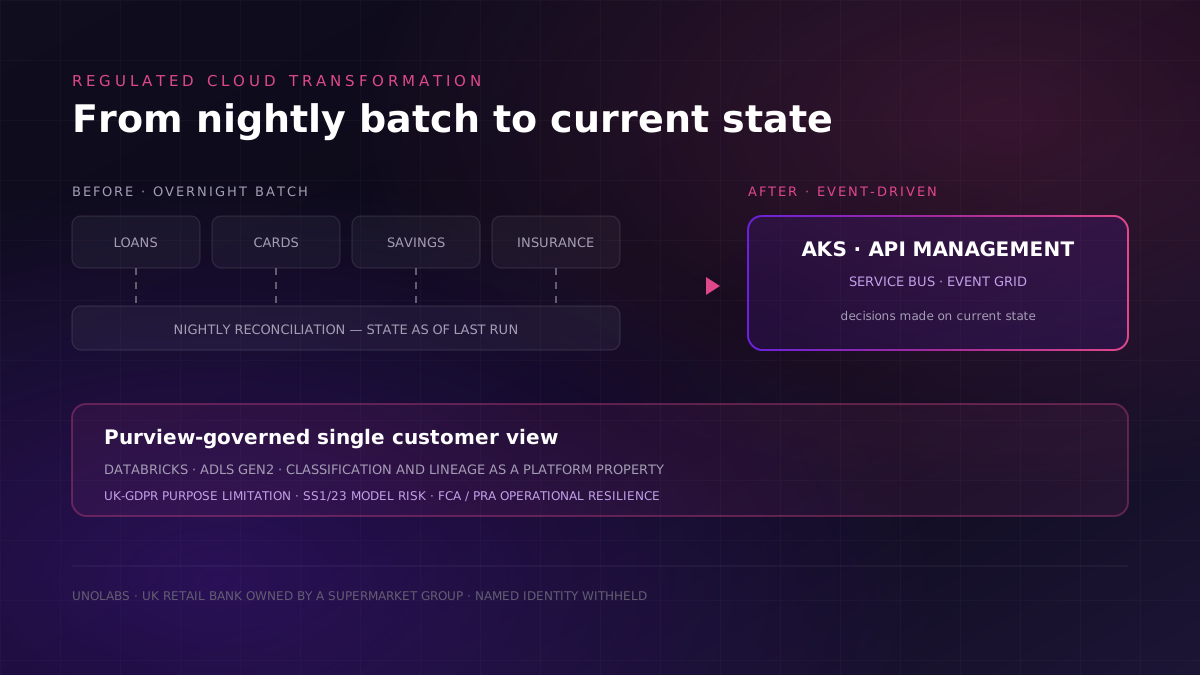
Purpose limits on joins
Fix what each customer join is permitted to serve before it is built, so purpose limitation can be demonstrated rather than asserted.
“Marketing asks for the single customer view assembled for servicing, and nobody can say on the record whether that reuse is permitted or who signed it off.”
Purpose and lineage register
Each customer domain mapped to the purposes its data may serve, with Purview classification and lineage held as a platform property — evidence a supervisor can be shown rather than told about.
Purpose limitation binds the commercial side hardest: a view assembled for servicing is not available to marketing, and someone senior holds that line.
Architecture Blueprint Sprint
Cutover on evidence
Sequence the migration so old and new paths run live together and each regulated journey cuts over on evidence, not on a programme date.
“A board-approved cutover date exists, and payments, lending decisions and card servicing cannot pause for it — nor can the bank defend a weekend that goes wrong.”
Parallel-run cutover plan
A per-journey sequence: what runs in parallel, which comparisons must agree before a journey moves, and the evidence authorising each cutover and each rollback.
Resilience is judged on behaviour under stress, not on architecture diagrams — an estate aligned the day it is built stays aligned only if it is exercised.
DQ Sentinel
Traceable model inputs
Hold quality and lineage checks inside the risk pipelines, so an SS1/23 review evidences a model's inputs instead of reconstructing them.
Data Engineering & Integration
Batch as control gap
Replace overnight batch with event-driven integration, so risk, fraud and servicing stop inheriting last night's view of the customer.
“A fraud or affordability decision turns out to have been taken on last night's view of the customer, and what moved in between is nobody's to reconstruct.”
Event contract pack
Per-journey event schemas with Service Bus and Event Grid topic design, plus the replay, ordering and idempotency rules each downstream consumer depends on.
The difficulty moves into the consumers: every downstream system has to cope with replay and out-of-order delivery, and older core systems often cannot.
Enterprise Data Platform Engineering
Landing zone as posture
Build the Azure landing zone so identity, network and data controls are inherited by every workload rather than re-argued per project.
Enterprise Decision Intelligence & Operational Analytics
One customer definition
Model risk, fraud and servicing on the governed single customer view, so a score and an offer rest on the same definition of a customer.
DevOps & SRE
Deployment speed as control
Put provisioning, governance and security on one coded path, so a regulated change arrives with its evidence already attached.
Start Your Banking & Financial Services Modernisation
We'll review your current architecture, identify immediate bottlenecks, and draft a production-grade roadmap for your autonomous transformation.
"Bring one regulatory report that hurts. We'll trace its lineage together."