Healthcare Services
Unolabs modernises sensitive health data into secure, governed, and high-fidelity data products. We build the longitudinal patient records and synthetic digital twins required for care coordination, claims intelligence, and accelerated clinical trial cycles.
For healthcare providers, biopharma leaders, care networks, and health analytics platforms.
Engineering specialised data zones and autonomous processing layers for Healthcare Services leaders.
Interoperable on paper, fragmented in practice
You've stood up the FHIR endpoints the 21st Century Cures Act requires, but the longitudinal record still lives across EHR instances, a claims warehouse, and an HIE feed nobody fully trusts. Every analytics request becomes a HIPAA minimum-necessary negotiation, and payer-provider exchange still runs on 837 files and portal scrapes. We build the identity-resolved, PHI-minimised layer that makes the record actually longitudinal.
Architectural Bottlenecks Hindering Healthcare Services Transformation
Clinical Data Silos: Patient, provider, and claims data are fragmented across EHR instances, claims warehouses, and HIE feeds, preventing a longitudinal view of the patient journey.
Compliance & Privacy Gravity: HIPAA minimum-necessary obligations and the need for rigorous audit trails often stall analytics and AI initiatives in care coordination.
Data Quality Latency: Inconsistent identity resolution and weak source-to-target lineage prevent the realisation of synthetic digital twins and trial acceleration.
Relevant patterns from industry work
Each pattern represents a validated technical outcome delivered for global enterprise clients.
Synthetic Trial Acceleration
Used synthetic digital twins to simulate control arms for a biopharma clinical trial, reducing the recruitment burden where identity resolution and PHI minimisation could be evidenced rather than asserted.
Ambient Clinical Documentation Ops
Scaled a generative ambient listening platform for a hospital network, automating clinical note generation and returning documentation time to clinicians across a multi-site network.
Read Technical ProofLongitudinal Patient Intelligence
Linked encounter, claim, and pharmacy data into a golden patient record, improving care coordination and utilisation analytics through predictive health timelines.
Healthcare Governed Data Flow
Clinical, claims, pharmacy, finance
Patient, provider, encounter, claim, appointment, lab, medication, and operational data enters from sensitive systems.
Privacy and identity layer
Data is classified, matched, masked, deduplicated, and governed with strict access and lineage.
Patient, provider, quality domains
Semantic data products connect care pathways, operations, utilisation, quality, finance, and risk.
Care, operations, analytics, AI
Approved outputs feed dashboards, reporting, care operations, quality improvement, and AI readiness programmes.
Diagnostic view of the Healthcare Services data stack
This blueprint details the specialised processing zones, control points, and delivery channels specific to the Healthcare Services landscape.
Expert insights for Healthcare Services
Enterprise migration and production operating model stories.
Industry Transformation Outcomes
Longitudinal Patient Intelligence
Accelerated Synthetic Trial Cycles
Governed Care Coordination
Engineering Healthcare Services Ecosystems
How our 2026 service catalogue integrates to solve high-growth industry challenges.
Semantic AI & Knowledge Graphs
Patient matching tolerance
Resolve one patient across EHR instances, a claims warehouse and an HIE feed, and write down the match thresholds analytics will rest on.
“An AI programme is approved on the assumption the record is already joined up; matching runs at a rate nobody has written down, and no one owns a wrong merge.”
Match rule decision record
Deterministic and probabilistic rules with their thresholds, what each side triggers — automatic link, stewarded review, refusal to merge — and the named owner of the clinical risk per error type.
No common key spans these systems, so identity is inferred: a wrong merge is a safety event, a missed one an operational cost, and the tolerance is the board's.
Security & Compliance
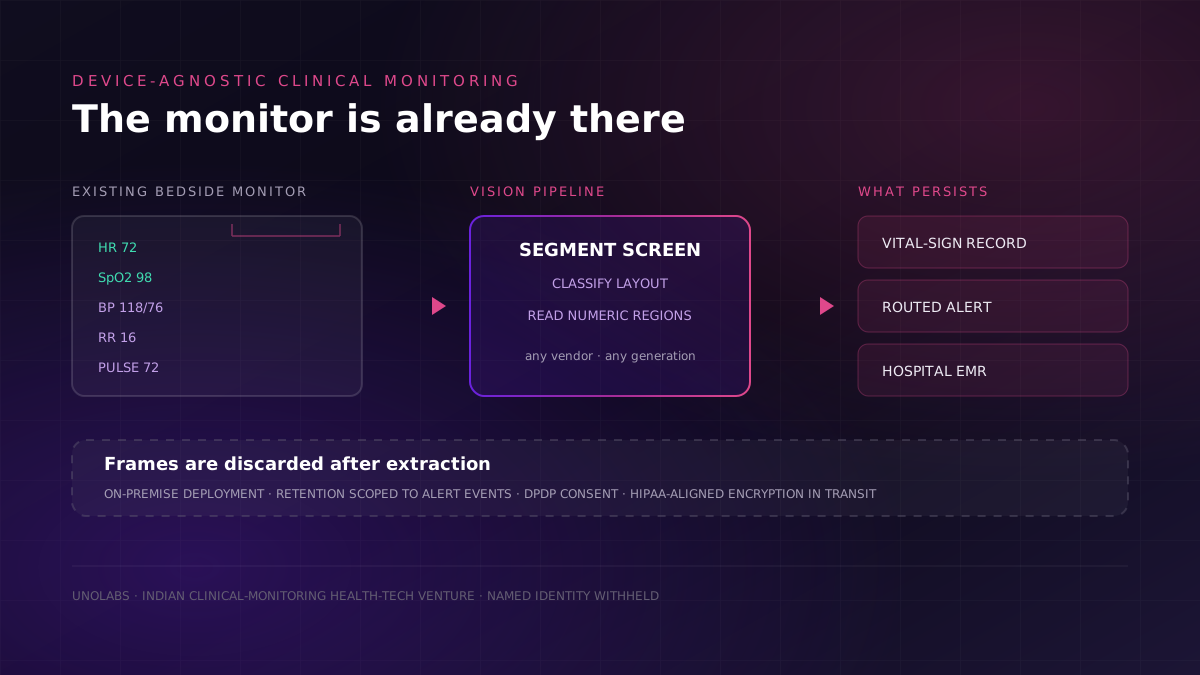
Retention as the control
Settle what may be retained before what may be watched, so extending a capability does not reopen the privacy case every time.
“A monitoring capability works on one unit and the board asks to extend it; the blocker turns out to be what the organisation is prepared to retain, not what can be built.”
Retention decision record
Per data class: what is processed, what persists, what is discarded, and the event that justifies keeping more — with the consent basis and encryption posture written down for a regulator.
A privacy board approves a purpose, not a platform, so each new unit or use case reopens the case unless retention is fixed per data class.
Enterprise Predictive Intelligence & Decision Forecasting
Per-patient thresholds
Baseline deterioration signals per patient and judge the model on alerts acted on, because an escalation nobody acknowledges is exposure.
“Clinical leads refuse another alerting system: the last one taught the unit to ignore alarms, and an unacknowledged escalation now sits on the risk register, not the backlog.”
Escalation policy record
One agreed route per alert class: who is notified, what context travels with the alert, the interval before escalation on non-acknowledgement, and the named owner of the response.
A personal baseline needs a history the unit has not yet accrued, so early weeks escalate against the agreed unit-wide score while that history builds.
Data Engineering & Integration
Bedside signal capture
Read vitals from the monitors already at the bedside and land them as coded observations, so coverage grows without a per-bed purchase.
Data Architecture
Secondary use boundary
Separate direct care from secondary use at the data-product edge, so minimum-necessary is a standing decision, not a per-request argument.
Enterprise Data Platform Engineering
Sovereignty by deployment
Run the platform inside the hospital's own estate, so data sovereignty is demonstrable at deployment rather than contractual.
Enterprise Decision Intelligence & Operational Analytics
Single cohort definition
Define the cohort once behind utilisation and pathway measures, so quality reporting and operations stop counting different populations.
Start Your Healthcare Services Modernisation
We'll review your current architecture, identify immediate bottlenecks, and draft a production-grade roadmap for your autonomous transformation.
"Bring the patient-matching problem your HIE couldn't fix. We'll walk the record."