Engineering Deep-Dives
CI/CD for Data Pipelines: Environments, Tests and Safe Releases
CI/CD for data pipelines: cloned-data environments, a testing pyramid for transformations, write-audit-publish releases, rollback, and when it is overkill.
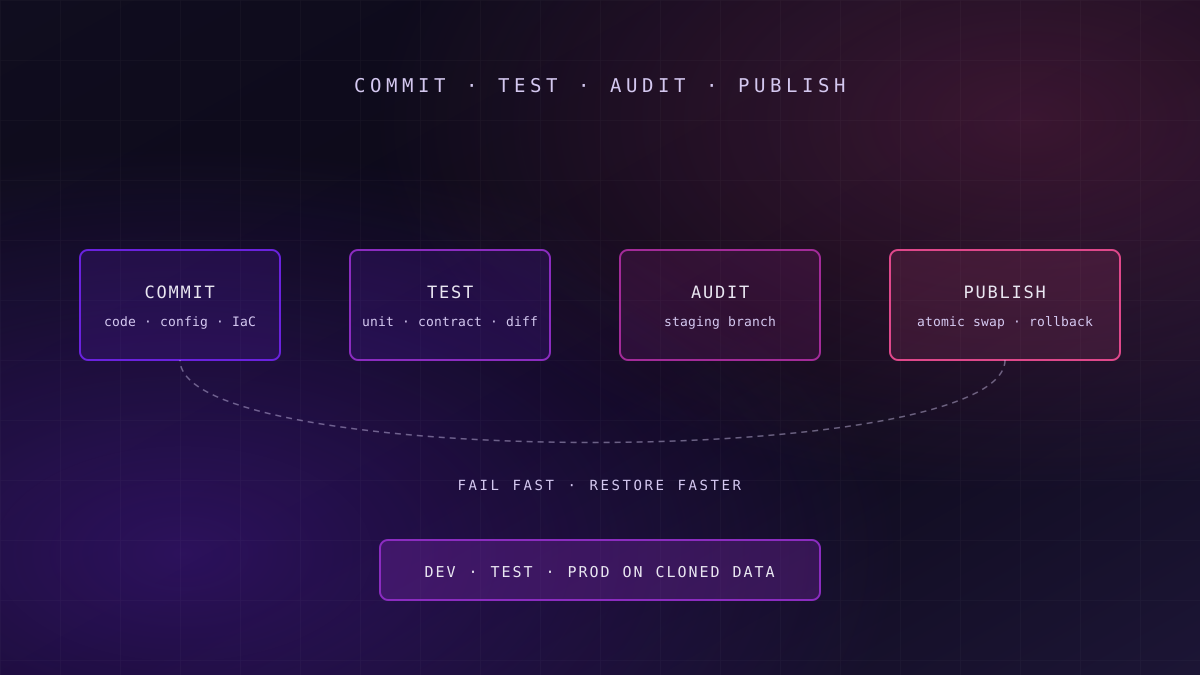
CI/CD for data pipelines means every change to transformation code, configuration or infrastructure is versioned, tested against realistic data in an isolated environment, and published to production atomically, with a rehearsed way back. The difference from application CI/CD is the data itself: a pipeline can pass every code test and still publish wrong numbers.
Most data teams already use Git. Fewer can say what happens between a merged pull request and a changed number on the finance dashboard. That gap is where releases go wrong, and it is the subject of this article.
Why Data Pipelines Need Their Own CI/CD Discipline
What this means for you: if a pipeline change can reach production without being run against representative data first, your release process is a hope rather than a control.
Application teams learned to ship small changes often, behind automated tests. Data teams adopted the same tools but not always the same discipline, because data breaks differently. A web service that fails returns an error. A pipeline that fails often returns plausible numbers that are wrong, and nobody notices until a board pack contradicts the ledger.
Speed without controls makes this worse, not better. Google's DORA research programme, in its 2024 Accelerate State of DevOps report, found that a 25% increase in AI adoption was associated with an estimated 7.2% reduction in delivery stability, even as individuals reported productivity gains. Data teams now generate SQL and Python with assistants too, and more code arriving faster raises the value of the tests and release gates around it.
Application failures shout. Data failures whisper plausible numbers into a board pack.
Two adjacent disciplines are covered elsewhere. Checking data quality rules inside the pipeline is the subject of our guide to governance as code. Building the shared platform that makes all of this self-service is covered in platform engineering and DataOps culture. This article sits between them: how a change moves safely from a laptop to production.
What CI/CD Means When the Product Is Data
What this means for you: define the release unit precisely, because a data release changes code, schema and data state together, and each needs its own test.
Continuous integration means every change is merged frequently and automatically built and tested. Continuous delivery means every merged change can be released to production through an automated, repeatable path. In data work, the artefact being released has three parts:
- Code: SQL models, Python transformations, orchestration definitions.
- Structure: schemas, table formats, permissions and the infrastructure underneath.
- State: the data already in tables, which a release may backfill, migrate or invalidate.
DataOps, the practice of applying DevOps and lean methods to data delivery, treats all three as one release. In our engagements, broken releases usually changed one of the three without testing its effect on the other two.
| Practice | Application CI/CD | Data CI/CD | What breaks if you skip it |
|---|---|---|---|
| Isolated environments | Containers per branch | Cloned or sampled data per branch | Tests run on toy data and miss real edge cases |
| Unit tests | Functions | Transformation logic on fixed inputs | Logic errors reach production unnoticed |
| Contract tests | API schemas | Table schemas and semantics | Downstream consumers break silently |
| Integration tests | Service calls | End-to-end runs and data diffs | Changes pass alone and fail together |
| Release | Blue/green deployment | Write-audit-publish or table swap | Consumers see half-written or unvalidated data |
| Rollback | Redeploy previous build | Restore previous table version and code | Recovery takes days of manual repair |
Environments: Giving Every Change Realistic Data
What this means for you: the quality of your tests is capped by the realism of the data they run on.
The classic pattern of development, test and production environments still applies, but copying production data into each is slow, expensive and often a privacy problem. Modern platforms offer better options.
Zero-Copy Clones and Branches
Snowflake's zero-copy cloning creates a new database, schema or table that shares the source's underlying storage; according to Snowflake's documentation, new storage is consumed only as the clone and the source diverge. Delta Lake's shallow clones and Apache Iceberg's table branches give similar isolation on lakehouse platforms. A pull request can therefore run against a full-size, current copy of production in minutes, not days.
Failure mode
Failure mode: clones that carry production access
A clone of production data is still production data. Teams that clone freely into developer environments often copy personal data into places with weaker access controls. Clone into governed environments, check how grants carry over, and mask sensitive columns before developers query them.
Masked and Synthetic Data
Where regulation or sensitivity rules out cloning, masked subsets and synthetic data fill the gap. Masking keeps real distributions while replacing identifying values. Synthetic data suits unit tests and demos but rarely reproduces the awkward edge cases that cause production failures: the null in a mandatory field, the duplicate key, the late-arriving record.
A practical rule: unit tests run on small fixed fixtures, integration tests on masked or cloned data, and nothing reaches production without one run at production scale.
The Testing Pyramid for Data
What this means for you: most data teams test only at the top, with slow end-to-end runs; push most tests down to where they are fast and precise.
Unit tests
Run one transformation on fixed input rows and assert the exact output. Fast, cheap and run on every commit.
Contract tests
Check that each published table still honours its agreed schema, types, keys and meaning, so consumers do not break.
Data diffs
Compare the changed pipeline's output with production's, row by row or by aggregate, and review every difference.
Integration runs
Run the full pipeline end to end on realistic data, including orchestration, dependencies and performance.
Unit Tests on Transformations
Unit tests check logic, not data quality. Given these five input rows, the revenue model must produce exactly these three output rows. dbt Core added native unit tests in version 1.8, released in May 2024, which removed much of the friction of testing SQL models this way. Python transformations can use standard frameworks such as pytest with small dataframes.
Contract Tests
A data contract is an agreement between a producer and its consumers about a dataset's schema, semantics and service levels. Contract tests in CI catch the change that renames a column or alters a grain before a downstream team finds out the hard way.
Data Diffs
Data diffs are the test most teams lack and most releases need. They answer the question a reviewer actually cares about: what will change in the numbers if this merges? A diff that shows revenue moving by 0.3% in one region is either an intended fix or a bug, and someone should decide which before release, not after.
Key idea
Review the data, not only the code
A pull request that changes a revenue model should show the revenue difference it causes. Code review alone cannot tell you whether a correct-looking join quietly duplicates rows.
Integration runs sit at the top: slower, costlier and essential before production, but too heavy to be the only line of defence.
Releasing Safely: Write-Audit-Publish and Atomic Swaps
What this means for you: consumers should only ever see data that has passed its checks, never a table halfway through being rebuilt.
Write-Audit-Publish
Write-audit-publish (WAP) is a release pattern in which a pipeline writes new data to an isolated staging location, audits it with quality checks, and publishes it to consumers only if the checks pass. On Apache Iceberg, the staging location can be a branch of the table, and publishing becomes a fast-forward of the main branch. On other platforms, the same effect comes from writing to a staging table and swapping it in.
Consumers should never be the first people to run your tests.
Blue/Green Tables and Feature Flags
Blue/green deployment keeps two versions of a dataset or schema and switches consumers from one to the other in a single step, often through a view or a schema alias. It suits larger structural changes, such as rebuilding a medallion architecture layer, where you want the old version available for instant fallback. Feature flags in orchestration let a new pipeline run in shadow mode, producing output for comparison without serving it.
The audit step is where the quality controls from data observability and quality management earn their keep: freshness, volume and distribution checks belong in the gate, not only on a dashboard afterwards.
Infrastructure as Code and Deployment Tooling
What this means for you: if an environment cannot be rebuilt from a repository, it cannot be tested reliably, and it cannot be recovered quickly.
Infrastructure as code (IaC) means defining warehouses, clusters, storage, permissions and jobs in version-controlled files rather than by hand in a console. Terraform is the common cross-platform choice. Platform-specific tools sit alongside it: Databricks Asset Bundles, generally available since April 2024, package jobs, pipelines and their configuration for deployment across workspaces, and dbt projects carry their own model definitions and environments.
Slim CI and Cost Control
Running every model on every pull request becomes slow and expensive as a project grows. dbt's state comparison and deferral features let CI build only the models a change touches, plus their downstream dependants, and reuse production results for everything else. The same principle applies on any platform: test what changed and what it affects, not the whole estate. Our playbook for controlling Databricks and Snowflake spend covers the compute side of this.
Readiness signal
Readiness signal: can you rebuild test from scratch?
Delete your test environment and recreate it from the repository. If that takes more than an afternoon, or needs someone's memory, your environments are not code yet.
Rollback: Planning the Way Back Before You Need It
What this means for you: a release process is only as good as its recovery time, so rehearse rollback before the incident that needs it.
Rolling back code is easy. Rolling back data is not, because a bad release may have written millions of rows, triggered downstream jobs and fed reports that people have already read. Three capabilities make data rollback practical:
- Table versioning: Delta Lake time travel, Iceberg snapshots and Snowflake Time Travel let you restore a table to its state before the release, within the retention window you configured.
- Idempotent pipelines: a pipeline that produces the same result when re-run for the same period can be fixed and replayed safely.
- Lineage: knowing which downstream tables and reports consumed the bad data tells you what else to restore or reissue.
Pipelines fed by change data capture from source systems need extra care, because replaying a stream after a fix must not apply the same changes twice.
When Full CI/CD Is Overkill
What this means for you: match the rigour to the blast radius; not every pipeline deserves four test layers and blue/green releases.
A small team running a handful of internal reports, with one consumer who can tolerate a day's delay, does not need clones per branch, data diffs and atomic swaps. Version control, a few unit tests on the logic that matters and a manual check before release may be proportionate. Exploratory notebooks and one-off analyses also sit outside the release process by design; forcing them through it slows discovery for little gain.
In practice
In practice: tier pipelines by consequence
We usually suggest three tiers. Regulatory, financial and customer-facing outputs get the full pyramid and write-audit-publish. Internal operational reporting gets unit and contract tests. Exploratory work gets version control and nothing more.
The opposite mistake is common too: a single release process designed for the most critical pipeline, imposed on everything, so teams route around it. Proportion keeps the controls credible.
Where to Start
What this means for you: pick one important pipeline and take it through the whole path before scaling the pattern.
- Choose the pipeline. Pick one that feeds a decision people care about, such as revenue, margin or a regulatory return, and has broken before.
- Put everything in the repository. Code, configuration, schemas and infrastructure, with a pull-request workflow and required review.
- Add the lower layers first. Unit tests on the riskiest transformations and contract tests on the published tables.
- Give pull requests realistic data. Zero-copy clones or masked subsets, created automatically per branch.
- Add a data diff to every review. Make the change in numbers visible before merge.
- Gate the release. Write-audit-publish or an atomic swap, with quality checks in the audit step.
- Rehearse rollback. Restore a table version and replay the pipeline in test, and time it.
For a tightly scoped first pipeline, this is typically weeks of work; extending it across an estate is a longer programme that belongs in a wider data engineering and integration plan. The release discipline itself is part of our DevOps and DataOps engineering work, and the quality gates connect to DQ Sentinel data quality operations.
Frequently Asked Questions
What is CI/CD for data pipelines?
CI/CD for data pipelines is the practice of versioning every change to transformation code, configuration and infrastructure, testing it automatically against realistic data in an isolated environment, and releasing it to production through an automated, reversible path. It differs from application CI/CD because it must also test the data a change produces, not only whether the code runs.
How do you test a data pipeline before production?
Use four layers. Unit tests check transformation logic on fixed input rows. Contract tests confirm published tables keep their agreed schema and meaning. Data diffs compare the changed output with production so reviewers see how numbers move. Integration runs execute the whole pipeline end to end on realistic data. Most tests should sit in the fast lower layers.
What is the write-audit-publish pattern?
Write-audit-publish is a release pattern in which a pipeline writes new data to an isolated staging location, runs quality checks against it, and publishes it to consumers only if the checks pass. On Apache Iceberg the staging location can be a table branch; elsewhere it is often a staging table swapped in atomically, so consumers never see unvalidated data.
How do you roll back a bad data release?
Restore the affected tables to their previous version using time travel or snapshots, redeploy the previous code, and re-run the pipeline for the affected period. This works when pipelines are idempotent and lineage shows which downstream tables and reports consumed the bad data. Rehearse the procedure in a test environment so recovery time is known before an incident.
Is full CI/CD worth it for a small data team?
Not for every pipeline. Small teams should tier pipelines by consequence: apply full testing and gated releases to regulatory, financial and customer-facing outputs, lighter unit and contract tests to internal reporting, and only version control to exploratory work. Proportionate controls are more likely to be followed than one heavyweight process applied everywhere.
Unolabs is a Data and AI first engineering consultancy, headquartered in the United Kingdom with engineering operations in Pune and active engagements across the UK, Australia, and Hong Kong. We help enterprises build the architectural foundation for autonomous AI execution — governed data platforms, semantic intelligence, and agentic systems that enterprises can stand behind.
If you are weighing how much release discipline your data pipelines need, book a discovery call and we will work through it with you.
More Where
This Came From.
New architectural deep-dives land every two weeks. Pick your channels and we will send them as they publish.
Continue reading
- Engineering Deep-DivesMLOps in Production: What It Takes to Keep a Predictive Model RunningWhat MLOps in production takes: feature pipelines, training-serving skew, drift monitoring, retraining triggers, approvals, rollback and clear ownership.13 min read
- AI Readiness & StrategyThe Agent Tax: Why Replacing Your RPA Bots with AI Agents Could Blow Up Your Automation BudgetSwapping RPA bots for AI agents turns a fixed automation cost into one that scales with volume. The four cost lines most business cases leave out.15 min read
- Agentic ArchitecturesDesigning Production Agentic AI Systems: Architecture Patterns, Guardrails, and EvaluationHow production agentic AI is built: the agent loop, typed tool contracts, guardrail config, evaluation harnesses, and the gates that grant autonomy safely.18 min read
Find out where your pipeline releases can break
We will walk one of your pipelines from commit to production, map which of the four test layers and release controls exist, and show you the cheapest gap to close first.
Book a Pipeline Release Review