Cloud Platform Engineering
Governance as Code: Automating Data Quality in the Cloud
Turn data quality rules, access policies, and data contracts into version-controlled artefacts that CI/CD enforces before bad data reaches consumers.
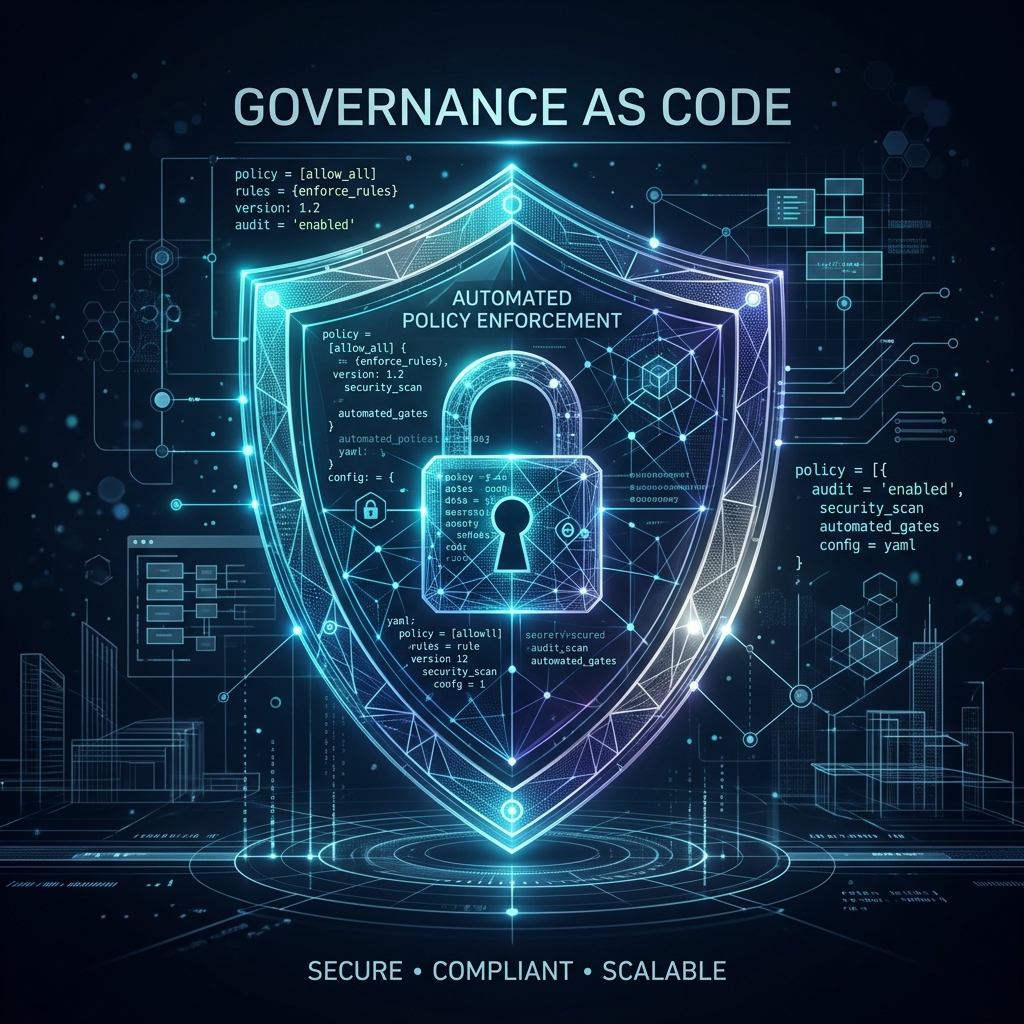
Governance as code means expressing data quality rules, access policies, retention requirements, and lineage expectations as version-controlled artefacts that pipelines enforce automatically. A schema change fails CI until the contract is updated. A pipeline that breaks a quality rule is blocked before consumers see bad rows.
Why Manual Governance Fails
What this means for you: if your governance lives in a spreadsheet and your changes ship daily, the gap between the two is your actual risk position.
Governance that lives in spreadsheets, wiki pages, chat threads, or quarterly review meetings never stays aligned with production. The rules exist. Nothing enforces them at the moment a change is made. The same gap is why AI governance turns out to be an engineering problem before it is a legal one.
Meanwhile the documentation describing how things should be drifts further from how things actually are:
- A developer renames a column and nothing downstream is consulted.
- A source system starts emitting nulls in a field that had been reliably populated for years.
- An analyst is granted access "temporarily", and the grant outlives the reason for it.
The failure pattern is structural rather than cultural. Manual checks fail on three axes at once:
- Too late. They run after data has landed and reports have shipped.
- Too infrequently. Audits are quarterly; changes are daily.
- Too far from the change. Reviewers lack the context needed to judge what is actually in front of them.
Failure mode
Governance people route around is not governance
A manual process bolted onto a fast delivery pipeline becomes friction, and friction gets bypassed. The residue is data debt: undocumented schema changes, quality rules living in one engineer's head, and access grants nobody remembers approving.
The fix is the one software engineering already applied to infrastructure and to security. Stop describing the desired state in documents. Declare it in code that machines verify on every change.
What Governance as Code Actually Means
What this means for you: four categories of governance intent become reviewable files in a repository, next to the pipelines they govern.
Quality rules as tests
Completeness, uniqueness, freshness, referential integrity and accepted-value rules written as declarative assertions that run automatically — not as checklist items a steward works through by hand.
Access policies as declarations
Who reads which datasets, which columns are masked for which roles, and how row-level restrictions apply — declared in policy files and changed only through reviewed pull requests.
Contracts as interface definitions
The schema, semantics and service-level objectives of a dataset, agreed between producer and consumers and checked mechanically on both sides.
Lineage expectations as metadata
Declared upstream dependencies and downstream consumers, so a proposed change can be assessed for blast radius before it merges rather than discovered through breakage after.
The access a person holds becomes derivable from the repository.
That property is the one auditors ask for, and it is the one a spreadsheet can never provide. Once these artefacts exist as code, everything the software lifecycle offers arrives with them: peer review of policy changes, a history of who changed what and why, rollback of a bad rule, and environment promotion of governance alongside the pipelines it governs.
The vocabulary here matters. Data governance as a discipline predates all of this; what changes is only where the rules live and what evaluates them.
Shift-Left Data Quality: Testing Before Merge, Gating Before Deploy
What this means for you: the cheapest place to catch a breaking change is a code review, and that is a scheduling decision more than a tooling one.
Traditional data quality operates at the right-hand end of the lifecycle — dashboards that flag bad data after it lands. Shift-left moves the checks to where changes originate.
At the pre-merge stage, a pull request that modifies a pipeline or a model runs contract tests in CI. Three questions get asked mechanically:
- Does the output schema still match the published contract?
- Do transformations still pass their rule assertions against representative test data?
- Does the change break a declared downstream dependency?
A failing check blocks the merge. The conversation about a breaking change then happens between engineers in a code review, rather than between a steward and an angry report consumer a week later.
At the deployment stage, CD gates verify governed properties in the target environment before a release goes live. Policy files are applied and verified, quality rules execute against a staging snapshot, and a release that would violate a contract objective is held.
A contract violation caught in CI costs a review comment. The same violation caught in production costs an incident, a backfill, and a little of the business's trust in the platform.
This is where a data quality platform earns its keep. Our DQ Sentinel service operates exactly this layer — contract validation, rule execution and quality gating wired into pipelines a team already runs — and the monitoring discipline that sits beside it covers what to watch once the gates are live.
Where Policy Decisions Are Evaluated
What this means for you: the engine you choose matters far less than the number of moments at which it is consulted.
A family of policy-as-code engines exists to separate policy definition from policy enforcement. They share a shape: policies are written in a declarative language, stored in version control, and evaluated at decision points. May this pipeline write to this dataset? May this role read this column unmasked? Does this schema change satisfy the contract? The engine returns allow, deny, or warn, and the platform acts on the verdict.
The important design choice is where those decision points sit. Mature setups evaluate policy at three moments: at review time as advisory checks in CI, at deployment time as hard gates in CD, and at runtime as continuous evaluation against live systems.
Key idea
A policy checked once is a policy you will drift away from
Review-time evaluation catches intent. Deployment-time evaluation catches the release. Only runtime evaluation catches the manual change somebody made in a console at 19:00 on a Friday. Three points, or the rule is advisory.
What happens at that third point once an estate gets large — machine-assisted classification, context-aware access decisions, compliance checks against live systems — is a discipline of its own, covered in automating governance decisions at runtime. This article stays with the delivery pipeline.
Data Contracts: Schema, Semantics, and Service Levels
What this means for you: the contract is the artefact that turns a schema change from a surprise into a negotiated, versioned event.
The data contract is the workhorse of governance as code. A useful one covers three layers that schemas alone miss: the structure (fields and types), the semantics (what each field means, who owns it, how sensitive it is), and the service levels (the freshness, completeness and availability the producer commits to).
contract: orders_daily
version: 2.3.0
owner: commerce-data-team
consumers: [finance-reporting, demand-forecast]
schema:
  - name: order_id
    type: string
    constraints: [not_null, unique]
  - name: order_total
    type: decimal(12,2)
    semantics: "Gross order value incl. tax, in settlement currency"
    constraints: [not_null, ">= 0"]
  - name: customer_email
    type: string
    classification: pii
    masking: hash_for_non_privileged
quality_slos:
  freshness: "available by 06:00 UTC daily"
  completeness: "row count within 5% of source system"
  null_rate: "order_total null rate = 0"
changes:
  breaking: require_major_version_and_consumer_signoff
  additive: allowed_with_minor_version
Everything in that file is mechanically checkable. CI validates producer output against the schema and constraints. The deployment gate verifies the quality objectives are being met in staging. The changes block makes schema evolution a negotiated event with a version number attached.
Because consumers are named in the contract, the platform knows who to notify and whose sign-off to require when a breaking change is proposed.
Failure mode
Contract sprawl kills these programmes
Writing a contract for every table is the most reliable way to end up with a large set of ignored artefacts. Contracts earn their overhead at producer-consumer boundaries that carry real risk, and nowhere else.
Drift Detection and Enforcement in CD
What this means for you: merge-time checks verify intent. Only drift detection verifies reality, and reality is what a regulator asks about.
Production systems drift, and they do it quietly:
- A source starts sending a new enum value nobody declared.
- A manually applied access grant bypasses the policy repository entirely.
- A table's freshness degrades from hours to days without crossing an alert threshold.
The continuous-delivery half of governance as code closes that gap with two mechanisms.
Drift detection continuously compares the declared state — contracts, policies and rules in the repository — against the observed state of actual schemas, actual grants and actual quality metrics. Divergence raises an alert with the diff, which is the same mental model as infrastructure drift detection applied to governance artefacts. Declared lineage is what makes an undeclared edge detectable at all.
Enforcement decides what happens on divergence, and the honest answer is graduated. New rules start in observe mode to build a baseline, move to warn so violations surface in CI and dashboards, and only then to enforce, where they block the merge, hold the deployment, or quarantine the data.
Failure mode
The first thing a hard gate blocks is usually a false positive
Jumping straight to enforcement on an unbaselined rule is how these programmes lose engineering goodwill in week one. Spend the weeks in observe mode; they are cheaper than rebuilding trust.
Governance Artefacts and Where They Are Enforced
| Governance artefact | As-code representation | Primary enforcement point | What breaks first if you skip it |
|---|---|---|---|
| Data quality rules | Declarative test assertions in the pipeline repository | CI on pull request; scheduled runs in production | Silent quality decay that surfaces as a disputed board number |
| Data contracts | Versioned contract files: schema, semantics, service levels | CI schema validation; CD gate on objective verification | Cross-team breakage nobody owns, resolved by escalation |
| Access policies | Policy files evaluated by a policy engine | CD apply-and-verify; runtime decision points | An access review you cannot answer from evidence |
| Retention rules | Declarative lifecycle configuration per dataset | Scheduled enforcement jobs with audit output | Personal data retained past its lawful basis |
| Lineage expectations | Declared dependencies in pipeline metadata | Pre-merge impact analysis; drift alerts on undeclared edges | Change impact discovered by outage rather than analysis |
| Masking and classification | Column-level tags and masking rules in contract or policy files | Query-time enforcement; CI checks on new columns | Sensitive columns exposed the day a new field lands |
A Rollout Playbook: Audit, Codify, Gate, Enforce
What this means for you: four stages, in order. Teams that attempt them simultaneously produce artefacts nobody trusts.
Audit
Inventory what governance exists today and where it lives — the spreadsheet of checks, the tribal knowledge about sensitive fields, the grants in the warehouse console. This stage produces the honest gap list.
Codify
Translate the inventory into artefacts, starting with the handful of datasets feeding critical reporting. A small set of enforced contracts beats a large set of ignored ones.
Gate
Wire the artefacts into CI in observe and warn modes. Let checks run on real pull requests for a few weeks, tune out false positives, and let engineers get used to governance feedback inside their normal workflow.
Enforce
Promote stable checks to blocking status in CI and CD, and switch on drift detection against production. From here the repository is the source of truth and divergence is an incident, not a mystery.
Readiness signal
You have arrived when
An auditor's question about who can read a column is answered by a file in a repository, and the engineer who last changed that file can be named from its history. Until then you have automation, not governance as code.
The cultural shift matters as much as the tooling, and it is the part that survives a reorganisation.
Governance stops being a team you ask permission from and becomes a property of the platform.
The same instinct underpins platform engineering and DataOps culture, and the enabling capability usually sits with the team that already owns DevOps and delivery automation.
Where governed data feeds AI systems, the evidence these artefacts produce is exactly what the regulatory operating model above them needs as input. What the data itself must look like first is set out in what an AI-ready foundation requires, and the resulting controls are what your security and compliance function will have to defend.
Frequently Asked Questions
How is governance as code different from writing data quality tests?
Quality tests are one artefact class within it. Governance as code extends the same version-and-enforce treatment to access policies, retention rules, data contracts, and lineage expectations. Critically, it wires all of them into enforcement points in CI and CD, so the repository both describes and controls the governed state rather than sitting alongside it as documentation that ages.
Which artefact should we codify first?
Data contracts for the two or three datasets that feed board-level or regulated reporting. They have obvious owners, obvious consumers, and an obvious cost of failure, which makes the first enforcement conversation easy to win. Access policies usually follow, because they carry the clearest audit value. Retention and lineage declarations are worth deferring until the first two are stable.
Do we need a data contract for every dataset?
No, and attempting one for everything is the most common way these programmes stall. Contracts earn their overhead where a producer-consumer boundary carries real risk: datasets feeding financial reporting, regulated data, and interfaces between teams. Internal scratch tables and exploratory datasets do not need contracts until somebody depends on them, at which point the dependency itself is the trigger.
Will blocking merges on governance checks slow engineering down?
Blocking on unbaselined rules will, which is exactly why the observe-warn-enforce progression exists. Once the rules are tuned, gates speed teams up on net: breaking changes are caught in review where they cost minutes, instead of in production where they cost incident response, backfills, and re-earned trust. Measure the change in lead time before and after.
Should governance artefacts live with the pipelines or centrally?
Keep contracts and quality rules with the pipeline code that produces the data, so a change to one forces review of the other in the same pull request. Cross-cutting policies — access, retention, classification standards — usually live in a shared repository owned by the platform team and consumed by every pipeline's CI. The split follows ownership rather than convenience.
Unolabs is a Data and AI first engineering consultancy, headquartered in the United Kingdom with engineering operations in Pune and active engagements across the UK, Australia, and Hong Kong. We help enterprises build the architectural foundation for autonomous AI execution — governed data platforms, semantic intelligence, and agentic systems that enterprises can stand behind.
If you are deciding which governance rules to codify first, or how to gate them without stalling delivery, book a discovery call.
More Where
This Came From.
New architectural deep-dives land every two weeks. Pick your channels and we will send them as they publish.
Continue reading
- Cloud Platform EngineeringPlatform Engineering and DataOps Culture: Turning Tool Sprawl into a Paved RoadHow platform teams turn data tool sprawl into a self-service platform: seven pillars, six capabilities, and the operating model that makes adoption stick.14 min read
- Cloud Platform EngineeringAzure Synapse to Microsoft Fabric: What Moves Cleanly, What Gets Rebuilt, and What Finance Must Decide FirstSynapse to Fabric migration, component by component: what Microsoft's tools move, what you rebuild, the capacity questions to settle, and when to wait.16 min read
- AI Readiness & StrategyThe Agent Tax: Why Replacing Your RPA Bots with AI Agents Could Blow Up Your Automation BudgetSwapping RPA bots for AI agents turns a fixed automation cost into one that scales with volume. The four cost lines most business cases leave out.14 min read
Move your first policy from a document into CI
Pick one rule that matters. We will codify it with your engineers, wire it into your pipeline, and show you the observe-warn-enforce path from there.
Book a Governance-as-Code Call