Data Governance Trends 2026
Adaptive Data Governance: Policy Automation That Keeps Pace With Change
Adaptive data governance in practice: automated policy enforcement, ML-driven data classification, and continuous compliance that keeps pace with change.
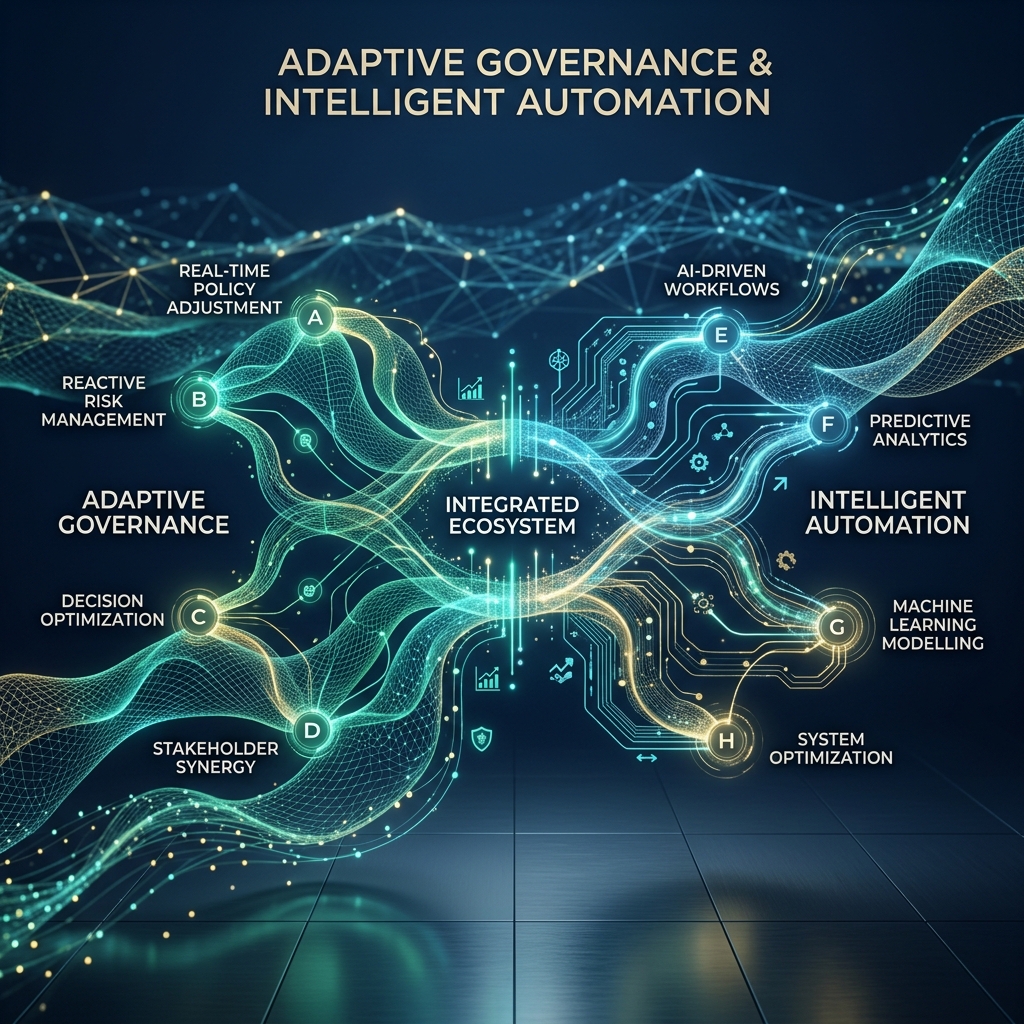
Adaptive data governance replaces review queues with policies evaluated automatically at ingestion, transformation, and consumption. Classification, quality gates, and access decisions run inside the pipelines themselves, so enforcement scales with data volume rather than with headcount. This article covers the five pillars, the automation ladder, and where to start.
Why Human Checkpoints Become the Bottleneck
What this means for you: the problem is not that your stewards are slow. It is that their throughput is fixed while your change rate is not.
Traditional data governance is built on human checkpoints: review boards that approve schema changes, stewards who validate quality by hand, access requests that wait in ticket queues. That model held while volumes were modest and changes were infrequent.
It stops holding for a structural reason rather than a cultural one. A control model whose throughput is bounded by human attention becomes the constraint on everything downstream of it, and the queue lengthens by exactly the amount that data volume and change frequency grow.
Enforcement that scales with headcount is not enforcement. It is a queue.
The symptoms follow predictably. Stewards spend most of their week on repetitive work — validating schemas, chasing lineage, updating catalogue entries — while the exceptions that genuinely need judgement wait behind them. Violations slip through during the wait. Quality degrades quietly. Audits arrive and trigger a scramble.
The direction of travel is not seriously disputed: Gartner has projected that by 2027, 60% of repetitive data management tasks will be automated. The interesting question is not whether to automate but which decisions are safe to hand over, and in what order.
Which Governance Decisions Are Safe to Automate
What this means for you: automate the decisions with a defined right answer first. Leave the judgement calls where they are until the telemetry says otherwise.
| Capability | What it replaces | What it needs before it works | Automate it now? |
|---|---|---|---|
| Policy evaluation at decision points | Review boards approving each change by exception | A declarative rule set with named owners and a test suite | Yes — this is the foundation everything else assumes |
| Automated quality gates | Manual validation of batches after they land | Agreed thresholds per dataset and a defined failure owner | Yes, on the pipelines feeding your most consequential reporting |
| Metadata and lineage upkeep | Stewards hand-maintaining catalogue entries | Connectors to the platforms that already emit this metadata | Yes — this is the highest-volume, lowest-judgement work you have |
| Sensitivity classification | Manual tagging of columns as they appear | A labelled sample to calibrate against, plus a review path for low-confidence calls | Partly — suggest automatically, confirm by human until precision is proven |
| Access provisioning | Ticket queues for routine, well-understood requests | Attribute-based rules and a clean identity source | Yes for routine requests; keep exceptions and elevated scopes human |
| Predictive quality alerting | Nothing — this is a new capability, not a replacement | Enough history for a baseline and an owner willing to act on a warning | Last. It multiplies a working foundation and cannot substitute for one |
Failure mode
Automating a bad rule scales the mistake
A policy that was ambiguous in a document becomes an ambiguous decision made a million times a day. The first automation candidate should be a rule whose correct answer nobody in the room disputes.
The Five Pillars of Adaptive Governance
What this means for you: these are capabilities to build in order, not features to buy in a bundle.
1. A Declarative Policy Framework
Governance rules are expressed in a declarative language such as OPA's Rego or Cedar, version-controlled, and evaluated by an engine wherever a decision is needed. Here is a simplified policy that blocks unmasked personal data from leaving the curated zone.
# policy: pii_egress_control (OPA/Rego-style pseudo-policy)
package governance.egress

default allow = false

# Movement within governed zones is permitted
allow {
    input.destination.zone != "external"
}

# Egress to external targets requires every PII column to be masked
allow {
    input.destination.zone == "external"
    not unmasked_pii_present
}

unmasked_pii_present {
    some col in input.columns
    col.classification == "pii"
    not col.masked
}

deny_reason = "unmasked PII columns cannot leave the curated zone" {
    not allow
}
Key idea
One rule, evaluated the same way everywhere
The property that no policy PDF ever had is identity of interpretation. The same rule returns the same verdict at the pipeline, at the query engine, and at the export endpoint — and every change to it has an author, a reviewer, and a date.
How those rules are authored, reviewed and promoted through a delivery pipeline is a discipline in its own right. This article is about what happens once they are running.
2. Automated Quality Gates
Statistical profiling, schema validation, and anomaly detection run on every batch and stream rather than on a review cadence. Failed checks stop propagation before downstream consumers inherit the defect.
The gates are only as good as the thresholds behind them, and thresholds need owners. Our DQ Sentinel practice operates this layer, and the observability discipline that tells you whether the thresholds are still right is covered in our guide to continuous data observability.
3. Context-Aware Access Control
Access decisions weigh user attributes, data sensitivity, and environmental context together rather than resolving to a static role. Attribute-based access control lets entitlements adjust as conditions change, which is what makes self-service access viable without a standing queue.
Routine and well-understood
A request that matches an existing attribute rule with no sensitivity escalation. Automate the decision and log it.
Routine but elevated
Access to classified or regulated data by an entitled user. Automate the evaluation, keep a human on the approval.
Genuinely exceptional
A request no rule anticipated. This is the work stewards should be doing, and it is what automating the first two categories frees them to do.
4. Intelligent Metadata and Classification
Auto-discovery of schemas, relationships, and lineage removes the largest block of repetitive steward work. Machine learning can propose sensitivity classifications from column names, values, and context.
Failure mode
A classifier's suggestion is not a classification
ML-assisted tagging is a productivity tool with a false-positive rate. Let it propose, route low-confidence calls to a human, and measure precision on a labelled sample before you let a suggestion bind an access decision.
5. Continuous Compliance and Remediation
Compliance checks run against the live estate rather than at audit time, producing evidence continuously: decision logs, the rule version in force at the time, and an exception register with owners.
Remediation can be automated for well-understood classes of failure — a quality breach triggering a defined cleansing path, a policy violation opening a ticket with context attached. Ambiguous failures should escalate rather than self-heal.
The Adaptive Governance Control Plane
What this means for you: four planes, and most enterprises have the first two while missing the third and fourth entirely.
┌────────────────────────────────────────────────────────────┐
│  POLICY PLANE — declarative rules under version control     │
│  • Rules in Rego or Cedar, reviewed like application code   │
│  • Tested against sample inputs before release              │
│  • One rule set, evaluated identically at every point       │
└────────────────────────────┬───────────────────────────────┘
                             │
┌────────────────────────────▼───────────────────────────────┐
│  DECISION PLANE — where the rule is actually asked          │
│  • Ingestion: schema, completeness, referential checks      │
│  • Transformation: classification propagation, masking      │
│  • Consumption: attribute-based access, egress control      │
└────────────────────────────┬───────────────────────────────┘
                             │
┌────────────────────────────▼───────────────────────────────┐
│  SIGNAL PLANE — what makes the rules adaptive               │
│  • Automated profiling and anomaly detection                │
│  • ML-assisted classification, reviewed before it binds     │
│  • Drift and violation telemetry fed back into rule design  │
└────────────────────────────┬───────────────────────────────┘
                             │
┌────────────────────────────▼───────────────────────────────┐
│  EVIDENCE PLANE — what an auditor is actually shown         │
│  • Decision logs: who asked, what was returned, and why     │
│  • Rule version in force at the time of each decision       │
│  • Exception register with a named owner per entry          │
└────────────────────────────────────────────────────────────┘
The signal plane is what earns the word adaptive. Without telemetry flowing back into rule design, you have automated governance rather than adaptive governance — faster, but no better calibrated than the day it was written.
A Four-Phase Build-Out
What this means for you: each phase is scoped to a defined set of rules and pipelines, not to the estate. Timings assume a single accountable owner.
Policy foundation
Migrate a small set of high-consequence rules into a declarative engine, with tests and a release path. Commonly eight to twelve weeks for a first rule set. Exit: rules are version-controlled and evaluated by an engine.
Quality gates at ingestion
Deploy profiling and validation on the pipelines feeding your most consequential datasets, with defined thresholds and named failure owners. Exit: defects are stopped before propagation on the gated paths.
Metadata and access automation
Turn on auto-discovery and ML-assisted classification with human confirmation, then move routine access decisions onto attribute rules. Exit: routine requests no longer queue.
Continuous evidence and prediction
Run compliance checks against the live estate, retain decision logs with rule versions, and only then add predictive quality alerting. Exit: audit evidence is produced as a by-product.
Readiness signal
You are ready for the next phase when
The rules from the previous phase have run in production long enough to produce a false-positive rate you can quote, and someone has tuned them at least once in response. Untuned automation is a pilot wearing production clothes.
What Changes for Your Team
What this means for you: the headcount question comes up in every steering group, and the honest answer is that the work changes rather than disappears.
Judgement stays human. The queue processing does not.
Automation absorbs the repetitive core of data management work — schema validation, classification tagging, lineage upkeep, routine access decisions. What is left is the part that required judgement in the first place: deciding what the rules should be, adjudicating the exceptions automation escalates, and owning the quality of the rules themselves.
Automation cannot decide what a rule should be. It can only apply the rule you wrote.
That is also the limit of the approach. An adaptive control plane makes a well-designed policy cheap to enforce everywhere; it does nothing for a policy that was wrong. Where governance is federated across domain teams — the pattern set out in our data mesh governance guide — the automation is what makes federated governance tractable rather than merely aspirational.
Two neighbouring disciplines complete the picture. The foundation these rules operate on determines whether the rules have anything reliable to act on at all. Where governed data feeds generative AI, the surrounding EU AI Act operating model sets the roles and gates around it.
Both eventually land on the desk of whoever runs security and compliance, and both belong in the same funding conversation as your data strategy.
Frequently Asked Questions
What is adaptive data governance?
Adaptive governance is an operating model in which policies are expressed as code and enforced automatically inside data pipelines and access paths, rather than through manual reviews and ticket queues. It combines declarative policy engines, automated quality gates, machine-assisted classification, and continuous compliance monitoring, so enforcement keeps pace with data volume and change frequency instead of lagging behind them.
What does policy-as-code mean in a data context?
It means governance rules — who may access what, which quality thresholds gate promotion, how sensitive data may move — are written in a declarative language such as Rego or Cedar, stored in version control, and evaluated by an engine at runtime. The payoff is consistency and auditability: one rule, interpreted identically wherever it applies, with an author and a history behind every change.
Does automated governance replace data stewards?
No, it changes what stewards do. Automation absorbs schema validation, classification tagging, lineage upkeep, and routine access approvals. Stewards move up a level: defining policies, adjudicating the edge cases automation escalates, and owning whether the rules themselves are still correct. In our engagements the steward headcount rarely falls; the backlog does, and the work becomes considerably harder to outsource.
Can we trust machine-assisted data classification?
Trust it to propose, not to decide, until you have measured it. Calibrate the classifier against a labelled sample, route low-confidence predictions to a human, and track precision by data domain. Once precision on a given class is demonstrably high and stable, that class can bind an access decision automatically. Treat any drop in precision as a production incident.
Where should an organisation start with adaptive governance?
Start with a small set of high-consequence rules — usually personal data handling and access control — because they have clear owners and obvious audit value. Then add automated quality gates at the ingestion points feeding your most critical datasets. Resist starting with the predictive and self-healing layers; they multiply the value of a policy foundation but cannot compensate for the absence of one.
Unolabs is a Data and AI first engineering consultancy, headquartered in the United Kingdom with engineering operations in Pune and active engagements across the UK, Australia, and Hong Kong. We help enterprises build the architectural foundation for autonomous AI execution — governed data platforms, semantic intelligence, and agentic systems that enterprises can stand behind.
If you are deciding which governance decisions are safe to automate first, book a discovery call and we will map them against your estate.
More Where
This Came From.
New architectural deep-dives land every two weeks. Pick your channels and we will send them as they publish.
Continue reading
- Data Governance Trends 2026Why AI Governance Is an Engineering Problem, Not a Legal OneAI governance holds or fails in the data platform, not the policy. What engineering-first governance looks like, and three tests to run before sign-off.16 min read
- Data Governance Trends 2026The EU AI Act and Your GenAI Operating Model: A Compliance-Ready BlueprintWhat the EU AI Act asks of GenAI deployers, and the operating model that satisfies it: named roles, four lifecycle gates, and evidence at each step.13 min read
- Data Governance Trends 2026AI-Ready Data Foundations: The Governance Work That Comes FirstAI-ready data foundations decide whether models scale: quality at source, resolved entities, lineage to prediction, and inventories a regulator can audit.11 min read
Decide which policy decisions are safe to automate
We will work through your current governance decisions with your team and separate the ones a control plane can make from the ones a human must.
Book a Policy Automation Review