Data Governance Trends 2026
Federated Governance for Data Mesh: Ownership Without Anarchy
Federated governance for data mesh: how domain ownership, global policy standards and computational governance scale without a central bottleneck.
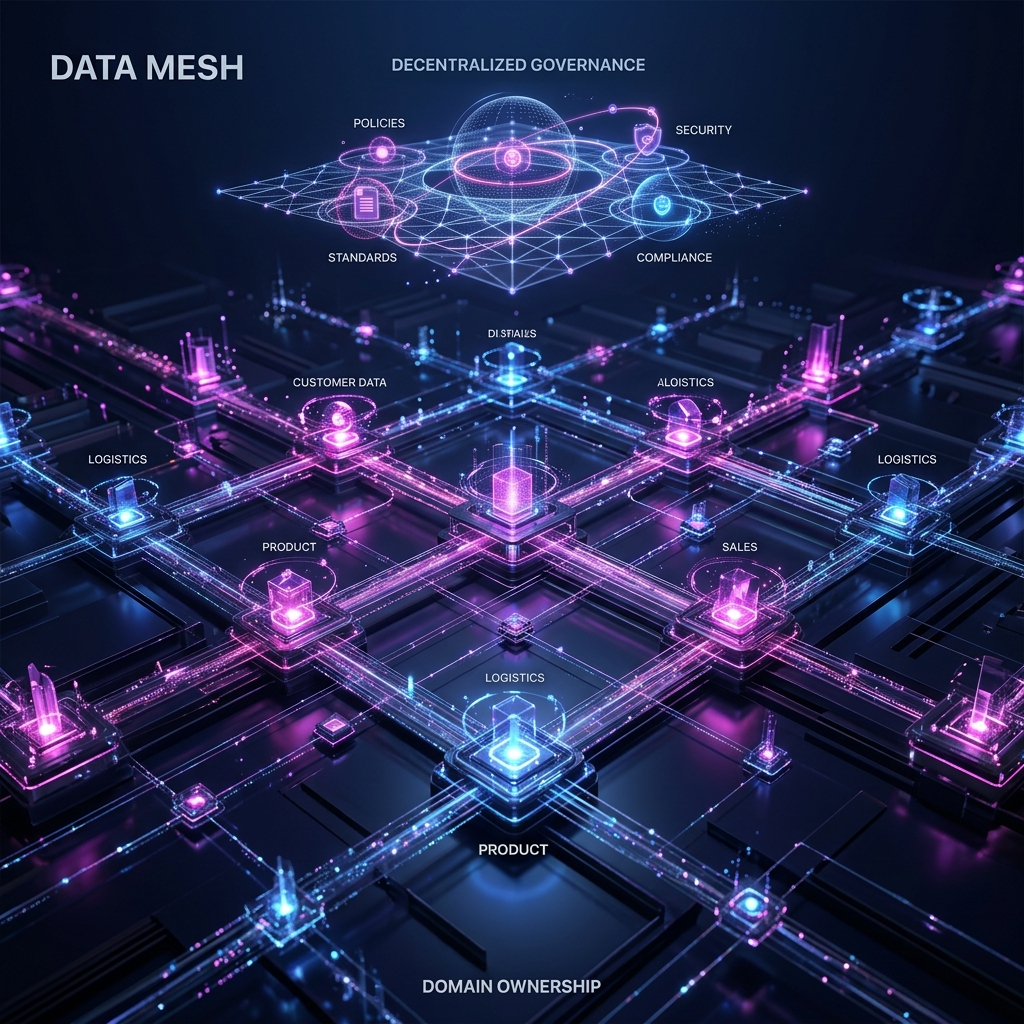
Federated governance is the operating model that lets domain teams own their data products while a small central function sets policy that is enforced in code rather than in committees. It replaces the central data team as gatekeeper with global standards, local implementation, and automated compliance checks inside every pipeline.
That sentence is easy to agree with and hard to implement. The difficulty is not the principle; it is deciding precisely which decisions stay central, which move to domains, and how you prove the arrangement is working before an auditor asks.
Why Centralised Data Teams Stall
What this means for you: if your data backlog grows faster than your data team, the constraint is your operating model, not your headcount plan.
The traditional centralised model behaves like a single toll booth serving an entire city. Every request — an analytics dashboard, a machine learning feature, a regulatory extract — queues behind the same team. That team is expected to understand every domain's semantics, build every pipeline, and govern every dataset.
The centralised data team does not fail because it is bad at its job. It fails because it is asked to hold context that no single team can hold.
The symptoms repeat across the estates we assess. Marketing waits weeks for a segmentation refresh. Product cannot iterate because the analytics pipeline is backlogged. Engineers spend a large share of their week translating business requirements into schemas for domains they barely know. The queue is not a staffing problem; adding people to it lengthens the coordination overhead as fast as it shortens the list.
Failure mode
More headcount does not shorten the queue
Every additional central engineer needs domain context they do not have. In our engagements, the teams that scaled fastest are the ones that moved the context to where the work happens rather than moving more work to where the context is missing.
Data mesh inverts this. Ownership of analytical data moves to the domains that produce it, and each domain publishes data as a product with a named owner, a contract, and a service level. Governance stops being a gate and becomes a standard.
This raises the obvious objection, and it is the right one. Distributed ownership without shared rules is not autonomy; it is fragmentation with better branding.
What Federated Governance Actually Means
What this means for you: federation is a decision-rights question before it is a tooling question — get the split wrong and you will pay for it in reconciliation work for years.
Federated governance has three moving parts. A central function defines the small set of policies that must hold everywhere. Domain teams implement those policies inside their own pipelines using shared platform components. And the platform makes compliance observable, so conformance is measured continuously rather than asserted in a quarterly review.
Federation is not the absence of control. It is control expressed as executable policy rather than as approval.
The point that gets missed is the third part. Global standards and local implementation are a familiar formula; without automated evidence they degrade into a policy wiki nobody reads. Computational governance is what makes the model hold — policy expressed as code, evaluated in the pipeline, with failures surfaced as build results rather than audit findings. We treat that as an engineering discipline in governance as code.
One boundary is worth stating plainly, because the two ideas are constantly conflated. This article is about the governance operating model inside a mesh. If your open question is whether a mesh or a fabric is the right architecture at all, that comparison is made in full in data mesh versus data fabric, and it is a different decision from this one.
The Six Capabilities Federated Governance Has to Deliver
What this means for you: use this as a checklist against your current estate — the last column is the only honest test of whether a capability exists or is merely funded.
| Capability | What it delivers | Who owns it | Signal it is real, not aspirational |
|---|---|---|---|
| Domain-driven ownership | Data owned by the team that generates and understands it | Domain data product owner | A named individual is accountable for quality and availability, and their name appears in the catalogue |
| Data as a product | Datasets with consumers, contracts, versioning and support expectations | Domain team | A consumer can find the schema, the refresh cadence and the breakage policy without asking a human |
| Federated computational governance | Global policy enforced locally and automatically | Central governance, implemented by domains | A policy violation fails a pipeline run rather than appearing in a monthly report |
| Self-service infrastructure | Standard ingestion, transformation, quality and observability components | Platform team | A new domain ships its first data product without the platform team writing code for it |
| Cross-domain composition | Products that compose into higher-order analytics without central ETL | Consuming domain | A composite product resolves lineage back through every contributing domain |
| Discoverability and observability | Metadata, lineage and quality metrics for every product | Platform, populated automatically | Registration is a by-product of deployment, not a separate task someone forgets |
The final column matters more than the rest of the table. Most organisations can claim five of these six on a slide. Very few can demonstrate the evidence column for more than two.
The Five Pillars of the Governance Framework
What this means for you: these are the five things a central function should own — and the list is deliberately short, because everything you add to it, a domain team stops owning.
Global Standards, Local Implementation
Central governance defines classification, retention, compliance obligations and metadata schemas. Domains implement them using platform-provided components rather than bespoke code. The distinction that keeps this workable: central owns the definition of the rule and the test that proves it holds; domains own the implementation and the remediation.
Classification and sensitivity
One enterprise scheme for personal, commercial and regulated data. Domains tag; they do not invent categories.
Retention and deletion
Obligations under UK GDPR and sector rules expressed as executable retention policies rather than as guidance documents.
Interoperability contracts
Common formats, naming and metadata schemas, so a consumer reads any domain's product using the same patterns.
Access and identity model
Attribute-based access control applied consistently, with federated identity spanning domains while security boundaries hold.
Data Product Service Levels
Every product publishes what it promises: availability target, refresh frequency, quality thresholds, and what happens when one is missed. Consumers choose between products on the strength of those published commitments. Breaches raise incidents automatically rather than being discovered by a business user.
The discipline behind this is a data contract between producer and consumer, backed by data quality service level objectives that fail loudly when reality drifts from the agreement. Our data quality engineering work starts at exactly this boundary, and the operational practice is set out in continuous data observability.
Interoperability by Default
Standardised metadata schemas make products discoverable. Shared lineage models track flow across domain boundaries. Consumers access any domain's data using consistent patterns, which is what makes composition cheap enough to be worth doing.
Access Control and Privacy
Sensitivity classifications are enforced globally, not per domain. Privacy obligations are embedded in the product template rather than reapplied by each team, which is the only version of this that survives a domain team under delivery pressure. Where the compliance perimeter is complex, our security and compliance practice sizes it before the mesh is designed, not after.
Quality and Observability
A standardised quality framework runs inside every domain pipeline. Domain-level and enterprise-level metrics come from the same instrumentation, so a central function can see aggregate health without reading domain code.
Key idea
Five pillars, one test
If a policy cannot be expressed as something a pipeline can evaluate, it is not a governance standard. It is an opinion with a stakeholder list, and it will be ignored the first time it is inconvenient.
Reference Architecture: A Federated Data Platform
What this means for you: the shape below is what the operating model looks like once it is built — three planes, each with a different owner.
┌──────────────────────────────────────────────────────────────────────────────┐
│                  FEDERATED GOVERNANCE & POLICY PLANE                          │
├──────────────────────────────────────────────────────────────────────────────┤
│                                                                               │
│  ┌────────────────────────────────────────────────────────────────────┐     │
│  │         Global Policy Registry (Centrally Managed)                 │     │
│  │  • PII Classification Policies                                     │     │
│  │  • Data Retention Rules (UK GDPR, sector regulations)              │     │
│  │  • Quality Standards & SLO Templates                               │     │
│  │  • Metadata Schema Standards                                       │     │
│  │  • Interoperability Contracts (APIs, Formats)                      │     │
│  └──────────────────────────────┬─────────────────────────────────────┘     │
│                                 │                                            │
│  ┌──────────────────────────────▼──────────────────────────────────────┐    │
│  │        Federated Compliance Monitoring                              │    │
│  │  • Cross-Domain Policy Validation                                   │    │
│  │  • Automated Compliance Dashboards                                  │    │
│  │  • Audit Trail Aggregation (All Domains)                            │    │
│  │  • Regulatory Reporting Automation                                  │    │
│  └─────────────────────────────────────────────────────────────────────┘    │
│                                                                               │
├───────────────────────────────────────────────────────────────────────────────┤
│                      SELF-SERVICE DATA PLATFORM                               │
├───────────────────────────────────────────────────────────────────────────────┤
│                                                                               │
│  ┌────────────────────────────────────────────────────────────────────┐     │
│  │           Platform Services (Managed by Platform Team)              │     │
│  │  • Data Catalogue (Automated Discovery + Lineage)                   │     │
│  │  • Quality Framework (Great Expectations, Soda)                     │     │
│  │  • Observability Stack (Prometheus, Grafana, Datadog)               │     │
│  │  • Access Control (ABAC with Federated Identity)                    │     │
│  │  • Data Product Templates (Starter Kits)                            │     │
│  └────────────────────────────────────────────────────────────────────┘     │
│                                                                               │
├───────────────────────────────────────────────────────────────────────────────┤
│                         DOMAIN DATA PRODUCTS                                  │
├───────────────────────────────────────────────────────────────────────────────┤
│                                                                               │
│  ┌──────────────────────┐  ┌──────────────────────┐  ┌─────────────────┐   │
│  │  Marketing Domain     │  │  Product Domain      │  │  Finance Domain │   │
│  ├──────────────────────┤  ├──────────────────────┤  ├─────────────────┤   │
│  │                      │  │                      │  │                 │   │
│  │ Data Product:        │  │ Data Product:        │  │ Data Product:   │   │
│  │ Customer Segments    │  │ Feature Usage        │  │ Transactions    │   │
│  │                      │  │                      │  │                 │   │
│  │ • Owner: Marketing   │  │ • Owner: Product     │  │ • Owner: Finance│   │
│  │ • SLO: availability  │  │ • SLO: freshness     │  │ • SLO: accuracy │   │
│  │ • Refresh: Daily     │  │ • Refresh: Streaming │  │ • Refresh: Hourly│  │
│  │ • Contract: v2.1     │  │ • Contract: v1.4     │  │ • Contract: v3.0│   │
│  │                      │  │                      │  │                 │   │
│  │ Pipeline:            │  │ Pipeline:            │  │ Pipeline:       │   │
│  │ • Ingestion          │  │ • Stream Processing  │  │ • Batch ETL     │   │
│  │ • Transformation     │  │ • Feature Eng        │  │ • Validation    │   │
│  │ • Quality Checks     │  │ • Quality Gates      │  │ • Enrichment    │   │
│  │ • Publishing         │  │ • Real-Time Serving  │  │ • Publishing    │   │
│  │                      │  │                      │  │                 │   │
│  │ Metadata:            │  │ Metadata:            │  │ Metadata:       │   │
│  │ • Schema             │  │ • Schema             │  │ • Schema        │   │
│  │ • Lineage            │  │ • Lineage            │  │ • Lineage       │   │
│  │ • Classification     │  │ • Classification     │  │ • Classification│   │
│  │ • Access Policies    │  │ • Access Policies    │  │ • Access Policy │   │
│  └──────────────────────┘  └──────────────────────┘  └─────────────────┘   │
│                                                                               │
│  ┌────────────────────────────────────────────────────────────────────┐     │
│  │            Cross-Domain Data Product Composition                    │     │
│  │                                                                      │     │
│  │  Marketing Segments + Product Usage + Finance Transactions =        │     │
│  │       → Customer Lifetime Value (Composite Data Product)            │     │
│  │                                                                      │     │
│  │  • Federated Queries (Query across domains)                         │     │
│  │  • No Central ETL (Domains expose queryable interfaces)             │     │
│  │  • Lineage Tracking (Composite products track source dependencies)  │     │
│  └────────────────────────────────────────────────────────────────────┘     │
│                                                                               │
├───────────────────────────────────────────────────────────────────────────────┤
│                    OBSERVABILITY & DISCOVERY                                  │
├───────────────────────────────────────────────────────────────────────────────┤
│                                                                               │
│  ┌────────────────────────────────────────────────────────────────────┐     │
│  │             Automated Data Catalogue (DataHub, Amundsen)            │     │
│  │  • Auto-Discovery of All Data Products                              │     │
│  │  • Search & Browse by Domain, Owner, Tags                           │     │
│  │  • Lineage Visualisation (Cross-Domain)                             │     │
│  │  • Data Product Documentation                                       │     │
│  └────────────────────────────────────────────────────────────────────┘     │
│                                                                               │
│  ┌────────────────────────────────────────────────────────────────────┐     │
│  │          Observability Dashboards                                    │     │
│  │  • Domain-Level Quality Metrics                                      │     │
│  │  • SLO Compliance Monitoring                                         │     │
│  │  • Data Product Health Scores                                        │     │
│  │  • Cross-Domain Dependency Maps                                      │     │
│  │  • Incident Detection & Alerting                                     │     │
│  └────────────────────────────────────────────────────────────────────┘     │
│                                                                               │
└───────────────────────────────────────────────────────────────────────────────┘
The three planes have three different owners, and the most common design failure is collapsing two of them into one team. When the platform team also writes domain pipelines, self-service never arrives. When central governance also runs the platform, policy and delivery compete for the same budget.
Deciding What Stays Central
What this means for you: this is the conversation to have before you buy anything, because the decision-rights split determines whether the platform you buy is used or worked around.
There is no universal answer, but there is a usable rule. A decision belongs at the centre when inconsistency across domains creates enterprise risk or blocks composition. Everything else belongs to the domain.
| Decision | Where it belongs | Why | Signal the split is wrong |
|---|---|---|---|
| Sensitivity classification scheme | Central | Inconsistent classification is a regulatory exposure | Two domains use different labels for the same personal data |
| Retention periods | Central | Obligations are enterprise-wide, not domain-specific | A deletion request has to be executed by hand per system |
| Schema design of a data product | Domain | The domain holds the semantics; central guesswork adds latency | Central architects are reviewing column names |
| Refresh frequency and service levels | Domain, published centrally | The domain knows the cost of freshness; consumers need to see it | Consumers discover the refresh cadence by watching the data |
| Tool selection for transformation | Platform, with a domain escape hatch | Standardisation buys reuse; absolutism drives shadow stacks | Domains run unregistered pipelines outside the platform |
| Access approval for a specific dataset | Domain owner, within central policy | Only the owner knows legitimate use; only central knows the rule | Every access request routes to one central inbox |
Readiness signal
You have federated correctly when
A domain can ship a new data product end to end without a central approval meeting, and a compliance officer can evidence policy conformance for that product without asking the domain a question.
Where the split is genuinely contested, the adaptive approach — tightening or loosening control by risk tier rather than applying one standard everywhere — is worked through in adaptive data governance.
Adopting the Model Incrementally
What this means for you: every failed mesh programme we have reviewed started by reorganising the whole estate at once. The phased route below is slower on paper and faster in practice.
Platform foundation
Build the self-service platform: catalogue, quality framework, observability, product templates. Agree global policy and the decision-rights split. Select one pilot domain. Typically 10-14 weeks for the first usable platform slice.
Pilot domain products
The pilot domain ships two or three data products on platform components, with published contracts and service levels. The outcome that matters is a repeatable pattern, not the products themselves.
Multi-domain expansion
Extend to three to five further domains and build the first composite products across them. Refine governance from what the pilot actually broke, not from what the design anticipated.
Enterprise scale
Migrate remaining centralised pipelines to domain ownership and complete compliance automation. This is the multi-year phase; each earlier phase should have paid for itself before it starts.
Two things distinguish the programmes that finish. The pilot domain is chosen for willingness rather than importance, so the pattern is proven by a team that wants it. And the platform is funded as a product with its own roadmap, not as a project that ends when the pilot ships.
Where Federated Governance Goes Wrong
What this means for you: these four failures account for most of the mesh programmes that quietly revert to a central team within eighteen months.
Federation without a platform
Domains are handed accountability with no self-service components to meet it. The result is not autonomy; it is the same work, done worse, in more places.
Policy that cannot be executed
Standards live in a wiki and conformance is self-reported. The first delivery deadline is the last time anyone checks.
Products with no consumers
Domains publish datasets nobody asked for because publishing was the target. Data product counts are a vanity metric; consumption and reuse are not.
A data product with no named consumer is not a product. It is a dataset with better documentation.
The fourth failure is the quietest: the central team never actually gives anything up. Approval gates are renamed rather than removed, and domain teams learn within a quarter that ownership was rhetorical. Federation demands that the centre lose something real — usually the right to approve — and replaces it with the right to define and to verify.
That trade is the whole model. Getting it right takes an explicit target operating design rather than a tool rollout, which is where our data strategy and data architecture work begins, and it is built on the platform capabilities described in our data platform engineering practice.
Frequently Asked Questions
What is federated governance in a data mesh?
Federated governance is an operating model in which a small central function defines the policies that must hold across every domain — classification, retention, interoperability, access — while domain teams implement those policies inside their own pipelines using shared platform components. Compliance is verified automatically by the platform rather than asserted in review meetings, so consistency is achieved without a central approval queue.
Which decisions should stay with the central data team?
Keep a decision central when inconsistency across domains creates regulatory exposure or prevents data products from composing. That usually means sensitivity classification, retention obligations, the access and identity model, and metadata standards. Schema design, refresh frequency, transformation logic and dataset-level access approval belong to the domain owner, who holds the semantics and bears the cost of the choices.
How is data mesh different from data fabric?
Data mesh is an operating model that redistributes ownership of analytical data to business domains. Data fabric is a technology architecture that uses active metadata to automate integration across a distributed estate. One answers an organisational bottleneck; the other answers integration complexity. Large enterprises frequently need both, and the two are not alternatives despite being marketed as such.
How long does a data mesh transformation take?
Expect a usable self-service platform slice in roughly three months, a proven pilot domain pattern within two quarters, and multi-domain operation inside the first year. Enterprise-wide migration of legacy centralised pipelines runs considerably longer and should be funded phase by phase. Programmes that attempt a single enterprise-wide reorganisation reliably stall before the platform is usable.
What is a data product owner accountable for?
A data product owner is accountable for the quality, availability and documented contract of their domain's published data — including the schema, the refresh cadence, the quality thresholds, and what happens when one of those promises is broken. They approve access within central policy. They are not accountable for building platform infrastructure; that belongs to the platform team.
Unolabs is a Data and AI first engineering consultancy, headquartered in the United Kingdom with engineering operations in Pune and active engagements across the UK, Australia, and Hong Kong. We help enterprises build the architectural foundation for autonomous AI execution — governed data platforms, semantic intelligence, and agentic systems that enterprises can stand behind.
If you are weighing how much governance to federate and how much to keep central, book a discovery call and we will map the decision-rights split against your own estate.
More Where
This Came From.
New architectural deep-dives land every two weeks. Pick your channels and we will send them as they publish.
Continue reading
- Data Governance Trends 2026Why AI Governance Is an Engineering Problem, Not a Legal OneAI governance holds or fails in the data platform, not the policy. What engineering-first governance looks like, and three tests to run before sign-off.16 min read
- Data Governance Trends 2026The EU AI Act and Your GenAI Operating Model: A Compliance-Ready BlueprintWhat the EU AI Act asks of GenAI deployers, and the operating model that satisfies it: named roles, four lifecycle gates, and evidence at each step.13 min read
- Data Governance Trends 2026AI-Ready Data Foundations: The Governance Work That Comes FirstAI-ready data foundations decide whether models scale: quality at source, resolved entities, lineage to prediction, and inventories a regulator can audit.11 min read
Work out which decisions belong to your domains
We will map your current governance decisions against the central-versus-domain split above and show you where the bottleneck actually sits.
Book a Governance Design Session