Data Platform Strategy
Snowflake vs Databricks: How to Choose for Enterprise Data and AI
Snowflake vs Databricks for enterprise data and AI: cost models, Iceberg and catalogue control, workload fit, operating effort, and when to run both.
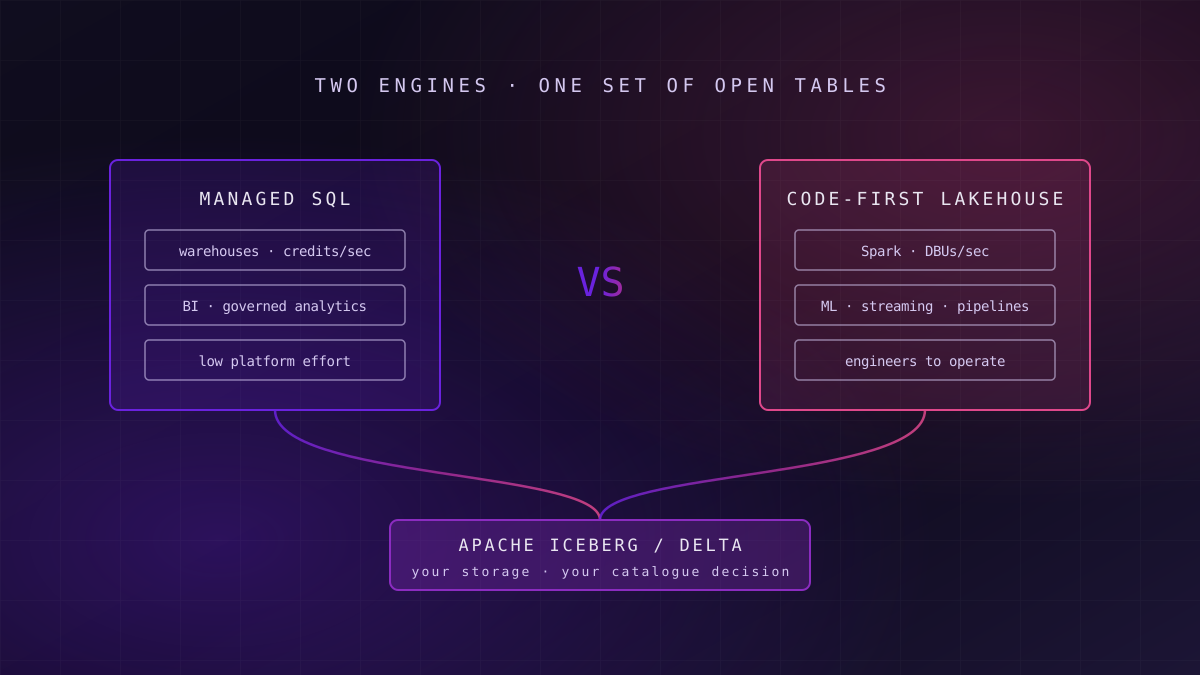
Choose Snowflake when the dominant workload is governed SQL analytics and you want a managed service a BI-led team can run with little platform engineering. Choose Databricks when code-first data engineering, machine learning and streaming dominate and you have engineers to operate it. Shared Apache Iceberg tables now make running both a credible, deliberate architecture.
Most comparisons of the two platforms are feature lists, and feature lists stopped being useful around 2023. Both vendors now sell SQL warehousing, notebooks, Python, streaming ingestion, governance and generative AI services. The question that still separates them is narrower: which operating model, cost behaviour and control of your tables suits the work you actually run.
Why Snowflake Versus Databricks Is Still a Live Decision
What this means for you: the platforms have converged on features, not on design philosophy, so the decision has moved from capability to fit.
Snowflake began as a cloud data warehouse and has spent several years moving towards engineering and AI workloads: Snowpark for Python and Java, Cortex for hosted language models, and native Apache Iceberg tables. Databricks began as a managed Apache Spark service and has moved the other way, adding serverless SQL warehouses aimed squarely at business intelligence.
The clearest signal that the contest moved to open tables came in June 2024. On 3 June, Snowflake announced the Polaris catalogue for Apache Iceberg, and Databricks announced its acquisition of Tabular, the company founded by Iceberg's original creators. Nine days later Databricks announced at its Data + AI Summit that it would open-source Unity Catalog.
The contest between these two vendors moved from who stores your data to who governs the tables that hold it.
Both then moved into operational databases. In 2025, Databricks agreed to buy the serverless Postgres company Neon for a reported sum of around $1 billion, and Snowflake agreed to buy Crunchy Data, a Postgres provider, for a reported sum of around $250 million. For a buyer, that means the platform chosen today will increasingly reach into application data as well as analytics, which raises the stakes of the catalogue decision covered below.
What Each Platform Actually Is
What this means for you: most poor platform choices begin with a loose definition, so pin down what you are buying before you compare it.
Snowflake is a fully managed cloud data platform that separates storage from compute. Compute runs in virtual warehouses that you size and suspend, and by default data sits in Snowflake-managed storage in a proprietary format, optimised for SQL. Snowflake runs on AWS, Azure and Google Cloud, and the vendor operates almost the entire stack, which is the core of its appeal.
Databricks is a lakehouse platform built on Apache Spark and Delta Lake, an open table format that adds transactions and versioning to files in object storage. Its classic compute runs in the customer's own cloud account, against data in the customer's own buckets; serverless compute runs in Databricks' account. Unity Catalog governs tables, files, models and permissions across workspaces. It runs on the same three clouds.
The practical difference is where responsibility sits. Snowflake trades control for operational simplicity. Databricks trades simplicity for control over compute, storage layout and code. Neither is a superset of the other, and the data lakehouse label each now claims hides that difference rather than resolving it.
| Dimension | Snowflake | Databricks | What it means for your decision |
|---|---|---|---|
| Origin | Cloud data warehouse | Managed Spark and lakehouse | The origin still shapes where each platform is easiest to use |
| Primary interface | SQL | Python, SQL, Scala in notebooks and jobs | Match it to the language your strongest team already writes |
| Default storage | Snowflake-managed, or Iceberg in your bucket | Delta Lake in your bucket | Decides how easily another engine can read your data |
| Compute billing | Credits per second, 60-second minimum per resume | DBUs per second by workload type, plus cloud costs on classic compute | Decides which cost discipline you must build |
| Operating effort | Low; the vendor runs almost everything | Moderate to high, falling with serverless | Decides how many platform engineers you need |
| Natural strength | Governed SQL analytics and data sharing | Engineering, machine learning and streaming | Start from the workload that carries the most value |
How the Cost Models Fail Differently
What this means for you: neither platform is cheaper in the abstract; each produces a different kind of surprise bill, and you should choose the one your team can control.
Snowflake bills compute in credits, consumed per second while a warehouse runs, with a 60-second minimum each time a warehouse resumes, according to Snowflake's documentation. Warehouse size sets the burn rate, and auto-suspend sets how long an idle warehouse keeps burning. Storage and serverless features such as Snowpipe are billed separately.
Failure mode
The Snowflake surprise is concurrency, not query speed
A warehouse that never suspends because dashboards refresh every few minutes, or a multi-cluster warehouse that scales out for a busy Monday and stays there, can quietly double a bill. The fix is suspension policy and warehouse-per-workload design, not faster SQL.
Databricks bills in Databricks Units (DBUs), metered per second, at rates that differ by workload type: jobs, all-purpose interactive clusters, SQL warehouses and serverless. On classic compute, the cloud provider bills the virtual machines separately, so a Databricks invoice is only part of the true cost. Serverless folds the infrastructure into the DBU price, which simplifies the bill but removes some levers.
The Databricks surprise is different: interactive all-purpose clusters left running for development, jobs running on the wrong cluster type, and oversized clusters nobody right-sized. These are discipline failures rather than design failures, and they respond to cluster policies, tagging and chargeback. The controls that keep either platform honest are set out in our playbook for controlling Databricks and Snowflake spend.
Readiness signal
Readiness signal: can you attribute last month's spend?
If you cannot name the team and workload behind the top ten cost lines on your current platform, consumption billing on either vendor will hurt. Build tagging and chargeback before migration, not after the first invoice.
Published price comparisons between the two are close to useless. They depend on edition, region, commitment discount and, above all, workload shape. A bursty BI estate and a steady overnight engineering estate can produce opposite answers on the same data volume. The only credible comparison is a modelled workload of your own.
Iceberg, Delta and Who Controls the Catalogue
What this means for you: open table formats lower the cost of leaving either vendor, but only if you also decide who owns the catalogue that tracks those tables.
Snowflake can now store data as Apache Iceberg tables in your own object storage, readable by other engines. It offers Snowflake Open Catalog, a managed service based on Apache Polaris, the Iceberg catalogue Snowflake donated to the Apache Software Foundation in 2024. External engines can also read Snowflake-managed Iceberg tables through its Horizon catalogue's Iceberg REST interface.
Databricks writes Delta Lake natively. UniForm lets Delta tables expose Iceberg metadata, so Iceberg-reading engines can query them, and Databricks has extended native Iceberg support since buying Tabular. Unity Catalog, open-sourced under the Apache 2.0 licence and hosted by the LF AI & Data Foundation, governs Delta and Iceberg tables alongside files and models.
Key idea
The catalogue is the new lock-in
A table in an open format that only one vendor's catalogue can govern is portable in theory and stuck in practice. Decide which catalogue is authoritative for permissions, lineage and table metadata before the first production table lands.
The common pattern in mixed estates is for Databricks to run upstream engineering and write curated tables as Iceberg on shared storage, with Snowflake reading them to serve BI. It works. The friction sits in permissions: two catalogues can each believe they own access control for the same table, and reconciling them is design work that someone has to own explicitly.
Your exit plan should therefore name three things: the format your tables are written in, the catalogue of record, and the engines that must be able to read them without copying. That is an enterprise data architecture decision, and it outlives any contract term.
Workload Fit: SQL, Engineering, Machine Learning and AI
What this means for you: list your workloads by business value, then judge each platform on the top three rather than on the long tail.
Governed SQL Analytics and Data Sharing
Snowflake's strongest ground remains SQL analytics for many concurrent business users, with workload isolation through separate warehouses and very little tuning. Secure data sharing across accounts, and its Marketplace, suit organisations that exchange data with partners or subsidiaries. Databricks SQL warehouses are a serious alternative, particularly where the data already sits in Delta, but they ask more of the team that runs them.
Data Engineering and Streaming
Databricks is the more natural home for heavy transformation in Python or Scala, complex pipelines, and streaming through Spark Structured Streaming, especially on a medallion architecture of bronze, silver and gold layers. Snowflake handles a great deal of engineering in SQL through Dynamic Tables, Snowpipe Streaming and Snowpark. The test is whether your hardest pipelines are best expressed in SQL or in code. Where they run at multi-petabyte scale, the tuning practice in our guide to lakehouse performance at petabyte scale applies.
Machine Learning and Generative AI
Databricks has the deeper machine learning tooling: MLflow, feature engineering on Spark, model serving and Mosaic AI for training, evaluating and serving models. Snowflake's Cortex brings hosted language models and search close to governed data with very little engineering, which suits teams that want AI over warehouse data rather than a model-building practice.
Buy the platform for the workload that carries most of your value, not for the one with the best launch event this year.
For predictive machine learning in production the depth of tooling matters. For retrieval and summarisation over governed tables, proximity to the data matters more. Teams building agentic AI systems should weigh both, because agents need governed data and controlled actions at the same time.
Operating Model and the Skills You Actually Have
What this means for you: the platform your current team can run well will outperform the theoretically better platform they cannot.
A Snowflake estate can be run by a strong analytics engineering team that writes SQL and dbt, with modest platform engineering. A Databricks estate needs people comfortable with cluster configuration, Spark behaviour, notebooks moving to production jobs, and CI/CD for code. Serverless options on Databricks narrow that gap but have not closed it.
Hiring markets differ too. SQL and dbt skills are broad and comparatively easy to recruit. Strong Spark engineers are scarcer and more expensive. If the strategy assumes a data engineering team that does not yet exist, the honest plan includes the time and cost of building it.
BI-led team, SQL-first
Most value sits in dashboards, finance reporting and governed metrics. Snowflake usually fits with the least operating effort.
Engineering-led team, code-first
Most value sits in pipelines, features and models built in Python. Databricks usually fits and rewards the investment.
Two strong teams, two centres of gravity
Analytics and data science both carry real value and both have capable teams. A deliberate split on shared Iceberg tables can be justified.
Whichever way you lean, define a semantic layer above the platform, so that metric definitions survive a later change of engine.
The Decision Matrix
What this means for you: score your own estate against each row; where five or more rows lean one way, the decision is usually clear.
| Dimension | Lean Snowflake when | Lean Databricks when | Signal you have scored it honestly |
|---|---|---|---|
| Dominant workload | SQL analytics and BI for many users | Engineering, ML and streaming | You ranked workloads by business value, not by volume |
| Team skills | SQL and dbt | Python, Spark and software engineering | You counted the people you have, not the people you plan to hire |
| Operating appetite | You want the vendor to run the platform | You want control of compute and storage layout | Someone owns platform operations by name |
| Cost behaviour | Predictable warehouse usage with firm suspension rules | Steady heavy jobs where right-sizing pays | You modelled real workload shape, not list prices |
| Data sharing | Frequent exchange with partners or subsidiaries | Mostly internal consumption | You listed actual sharing agreements |
| Openness | Iceberg in your bucket via Open Catalog or Horizon | Delta with UniForm and Unity Catalog | You named the catalogue of record |
| AI ambition | AI over governed warehouse data | Model training, features and serving | You named the first three AI use cases |
| Existing estate | SQL warehouse and BI tools dominate | Spark, notebooks or Delta already in use | You costed the migration of what already runs |
If the matrix splits evenly, that is information in itself. It usually means the estate has two genuine centres of gravity, which brings the next question into view.
When Running Both Is Right, and When It Is Not
What this means for you: running both is a legitimate architecture when it is designed, and an expensive accident when it is inherited.
Running both is defensible when analytics and data science are both large, both well staffed and both valuable, and when the boundary between them is clear: Databricks writes curated tables, Snowflake serves them, and one catalogue is authoritative. Our Fabric versus Databricks decision guide reaches a similar conclusion for Microsoft-centred estates.
Failure mode
Failure mode: two platforms, two copies, two truths
When both platforms ingest the same sources independently, every core metric is computed twice and the two answers drift. The cost is not only double compute; it is a finance director asking which revenue number is right.
Running both is the wrong call for a mid-sized estate with one data team, where two platforms double the skills, governance and cost-control burden for little gain. It is also wrong when the motive is to avoid a decision: two platforms chosen to keep two stakeholder groups happy is a political settlement, not an architecture. In those cases, pick the platform that fits the highest-value workload and accept that the long tail will be handled less elegantly. The same discipline applies to the wider debate in data mesh versus data fabric: structure should follow ownership, not compromise.
Where to Start: A Four-Week Evaluation
What this means for you: a short, evidence-based bake-off on your own data will settle what months of vendor presentations cannot.
Inventory and rank
List workloads, users, data volumes and skills. Rank workloads by business value and pick the three that matter most.
Model the cost
Translate the three workloads into warehouse hours and DBU hours with realistic concurrency, suspension and cluster policies.
Prove on real data
Run the same pipeline, query set and one ML or AI task on both platforms, on a copy of your own data.
Run the exit test
Write tables in the chosen open format, read them from a second engine, and confirm who governs permissions.
Scope matters here: four weeks covers a decision on three representative workloads, not a full migration plan. The migration itself, including reconciliation of every report that moves, is multi-quarter work best run as a factory with repeatable migration patterns and reconciliation. Platform choice, cloud landing zone and governance design then form one enterprise data platform build rather than three disconnected projects.
At the end, write the decision down: the workloads it was based on, the costs modelled, the exit route tested and the conditions under which you would revisit it. That record is what answers the board when it asks why.
Frequently Asked Questions
Is Snowflake or Databricks better for enterprise analytics?
For SQL analytics and business intelligence serving many users, Snowflake is usually the simpler choice because the vendor operates almost the whole platform and workload isolation needs little tuning. Databricks SQL warehouses are a credible alternative where data already sits in Delta Lake and the team is comfortable operating the platform. The deciding factors are workload mix, team skills and appetite for running infrastructure.
Is Databricks cheaper than Snowflake?
Neither is cheaper in general. Snowflake bills credits per second while warehouses run, with a 60-second minimum on each resume. Databricks bills DBUs per second by workload type, and on classic compute the cloud provider bills the virtual machines separately. Which costs less depends on workload shape, concurrency and cost discipline, so model your own workloads rather than comparing list prices.
Can Snowflake and Databricks share the same data?
Yes. Both platforms can read and write Apache Iceberg tables held in your own cloud storage, and Databricks can expose Delta tables to Iceberg readers through UniForm. A common pattern is Databricks writing curated tables that Snowflake reads for business intelligence. The design work is deciding which catalogue is authoritative for permissions, so the two platforms do not enforce conflicting access rules on the same tables.
Which is better for machine learning and AI?
Databricks offers deeper tooling for building models, including MLflow, Spark-based feature engineering, model serving and Mosaic AI. Snowflake's Cortex brings hosted language models and search close to governed warehouse data with little engineering effort. Choose Databricks for a model-building practice, and Snowflake when the priority is applying AI to governed data with a small team.
How long does a Snowflake versus Databricks evaluation take?
A focused evaluation on three representative workloads typically takes around four weeks: inventory and ranking, cost modelling, a proof on real data, and an exit test that reads tables from a second engine. That settles the platform decision. Migrating the full estate afterwards, with reconciliation of every report that moves, is a separate multi-quarter programme.
Unolabs is a Data and AI first engineering consultancy, headquartered in the United Kingdom with engineering operations in Pune and active engagements across the UK, Australia, and Hong Kong. We help enterprises build the architectural foundation for autonomous AI execution — governed data platforms, semantic intelligence, and agentic systems that enterprises can stand behind.
If you are weighing Snowflake against Databricks, or whether to run both, book a discovery call and we will work through it with you.
More Where
This Came From.
New architectural deep-dives land every two weeks. Pick your channels and we will send them as they publish.
Continue reading
- Data Platform StrategyBig Data Analytics in Retail: The Five Use Cases That Pay Back, and What Each One Needs FirstBig data analytics in retail pays back in five places. What each use case needs, where it stops paying off, and the platform UK retailers build first.14 min read
- Data Platform StrategyHow to Choose a Data and AI Consultancy: A Buyer's ChecklistA vendor-neutral checklist for choosing a data and AI consultancy: the questions to ask, the evidence to demand, the red flags, and how to test the exit.13 min read
- Data Platform StrategyReference Architectures and Industry Data Templates: When a Head Start Pays Off, and When It Costs YouWhen an industry data template or reference architecture speeds a data platform, when it slows one down, and how to decide before the build starts.13 min read
Test Snowflake and Databricks on your own workload
We will model your real query, pipeline and ML mix against both platforms and give you a written recommendation, including the exit test and whether running both pays.
Book a Platform Bake-Off