Enterprise AI Architecture
The Autonomous Enterprise Architecture: Four Layers, and Why AI Programmes Stall Without Them
Most enterprise AI programmes stall on architecture, not models. The four layers of autonomous enterprise architecture, and why sequence decides results.
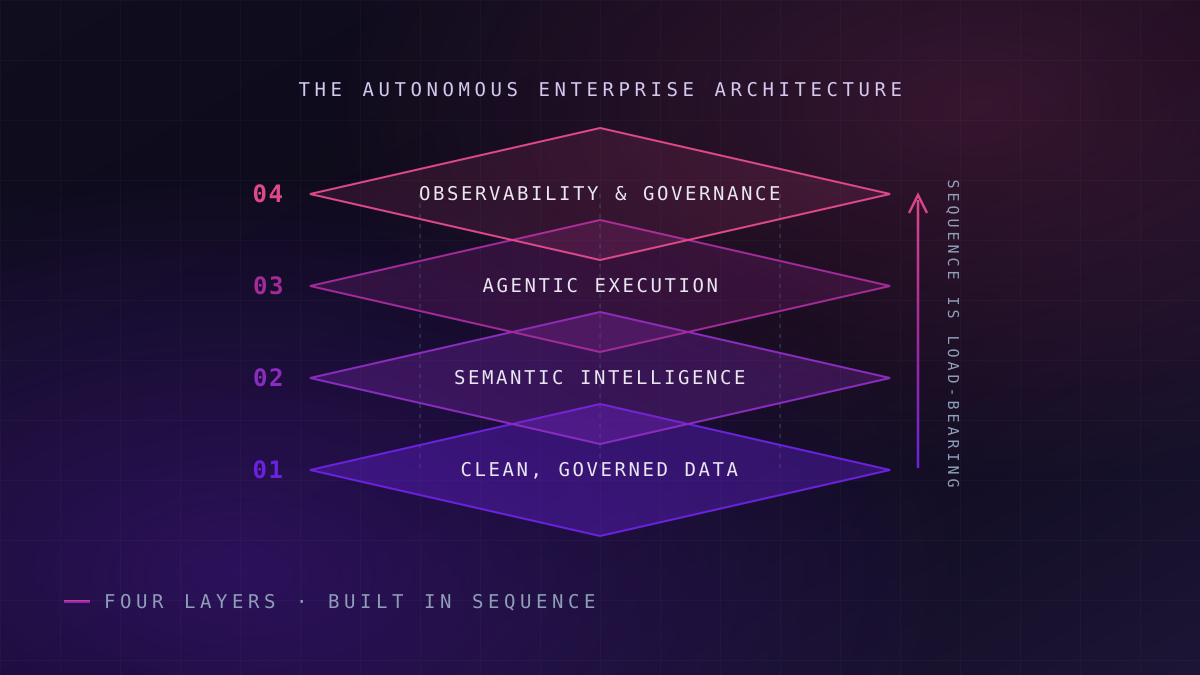
An autonomous enterprise is one where AI systems act within defined boundaries rather than only surfacing insight for humans to act on. It rests on four load-bearing layers: governed data, semantic intelligence, agentic execution, and observability with governance. The layers are sequential, not modular, and most enterprise AI programmes stall by building Layer 3 first.
UK AI activity is at record levels. Research commissioned by the Department for Science, Innovation and Technology and published in September 2025 put AI-related business revenues at £23.9 billion for 2024, more than double the 2022 figure. Adoption is near-universal: McKinsey's 2025 global survey found 88% of organisations using AI in at least one function.
And yet the returns are not showing up. MIT's 2025 study of enterprise generative AI found roughly 95% of pilots delivering no measurable impact on the P&L. In the same McKinsey survey, only about 7% of organisations reported AI fully scaled, and only 17% placed responsibility for AI governance at board level — so the commitment that does exist is rarely owned where accountability lives.
Failure mode
Adoption is near-universal. Returns are not.
88% of organisations use AI somewhere. About 7% have scaled it. The distance between those two numbers is not a model gap, and no better model closes it. It is an architecture gap, and it is where most enterprise AI budgets currently sit.
The reasons given are usually the same: the model was not ready, the use case was too narrow, the data was messier than expected. These explanations feel plausible. They are also mostly wrong.
The real problem is architectural. Enterprises are trying to build intelligent, autonomous systems on foundations that were never designed to support them — attempting to reach the top floor of a building whose ground floor has not been finished.
This piece sets out what that foundation actually looks like, why it matters to UK enterprise leaders specifically, and what the path from AI experimentation to genuine autonomous execution requires at every layer.
What an Autonomous Enterprise Actually Means
The phrase gets used loosely. Marketing teams apply it to anything involving a chatbot or a recommendation engine. That usage obscures a more precise and more useful definition.
An autonomous enterprise is one in which AI systems do not merely surface insights for humans to act on. They act directly, within defined boundaries, across interconnected workflows, with full traceability of every decision they make.
The human role shifts accordingly: from executing decisions, to setting the boundaries within which decisions are made and reviewing the exceptions that fall outside them. This is not a vision statement. It is an engineering target with a specific architecture — four layers, each of which must be solid before the next one can bear weight.
The Four Layers at a Glance
Read what follows as a diagnostic rather than a roadmap. The column that matters most is the last one, because it is the only honest way to tell whether you have finished a layer or merely started it.

| Layer | What it delivers | Failure mode if skipped | Signal you are ready for the next layer |
|---|---|---|---|
| 1. Clean, governed data | Raw separated from business-ready, contracts that survive upstream change, lineage to source | AI amplifies unreliable data — not occasional uncertainty, but systematic, confident wrong answers at scale | Two teams asking the same question get the same number, and every critical figure traces to where it came from and when it last changed |
| 2. Semantic intelligence | Governed measures, resolved entities, and a graph of the relationships between them | Retrieval without reasoning: "customers", "clients", and "accounts" stay three concepts, and confidence outruns comprehension | Agents traverse relationships rather than match keywords, and cross-department answers agree without reconciliation |
| 3. Agentic execution | Action inside the workflow — route, check against SLA, escalate, log — not a recommendation in a dashboard | Automation theatre, or ungated agents that commit decisions at full speed | Workflows complete end to end with every action logged, and exceptions escalate by rule rather than by meeting |
| 4. Observability and governance | Traces and costs per action, an owner per decision, an audit trail per exception, role-based access control (RBAC) scoping every agent | An autonomous black box — the first serious incident sets the programme back by years | Human oversight and decision traceability are demonstrable to a regulator before deployment, not reconstructed after an incident |
Layer 1: Clean, Governed Data
What this means for you: if two teams still answer the same question with two different numbers, nothing built above this layer will hold. Everything else in this article is premature until it is fixed.
Most enterprises believe they have a data problem. They actually have a trust problem.
Why Data Reliability, Not Volume, Is the Real Blocker
When a source system renames a field overnight, pipelines break. When two teams pull a report on the same question, they get different numbers. Data engineers spend a large share of their time repairing things that should not be breaking rather than building things that do not yet exist.
That is not a data volume problem. It is a data reliability problem — and it matters acutely for AI, because AI systems amplify whatever they are built on.
A model trained on unreliable data does not produce unreliable outputs occasionally. It produces them systematically, at scale, with confidence.
The failure mode of AI on bad data is not uncertainty. It is a very expensive, very consistent production of wrong answers.
What Layer 1 Requires: Separation, Contracts, and Lineage
Three things make this layer load-bearing.
Separate raw ingestion from business-ready consumption. A medallion architecture is the common expression of this — bronze for what arrived, silver for what has been validated, gold for what the business consumes — but the pattern matters more than the vocabulary.
Transformation logic has to be testable and maintainable independently of whatever the source system does next.
Make upstream change non-breaking through contracts, not hope. "Metadata-driven pipelines" is where most architecture documents stop, and it is not enough: a metadata-driven ingest survives a new column, but it does not survive a status code quietly changing meaning.
What survives that is a data contract between producer and consumer, schema-compatibility checks that run in CI, and freshness, volume, and distribution service level objectives (SLOs) that fail loudly when reality drifts from the agreement. Our data engineering work starts here, and the discipline behind it is set out in continuous data observability.
Treat lineage as an operational necessity, not a compliance checkbox. Be honest about fidelity. Table-level lineage across the estate, with column-level lineage on the paths that feed regulated reporting and AI features, is achievable and useful. Claiming column-level lineage everywhere is how lineage programmes lose credibility in month four.
Readiness signal
You have finished Layer 1 when
Two teams asking the same question get the same number, and every critical figure traces to where it came from and when it last changed. Until that holds, semantic modelling on top of it is decoration.
Once the numbers agree, the constraint stops being accuracy. It becomes meaning.
Layer 2: Semantic Intelligence
What this means for you: if your AI can find the right document but cannot connect it to the entity, the measure, or the obligation it depends on, this layer is your ceiling — not the model.
Why Better Retrieval Stops Paying Off
A vector search that returns the three most similar documents to a query is a sophisticated form of pattern matching. It is impressive in a demo. In production, when the stakes are real and the edge cases multiply, it is not enough.
Retrieval is not reasoning.
That distinction matters enormously, and most enterprise AI deployments collapse it entirely.

The mechanism behind that ceiling is worth naming, because it explains why better retrieval stops paying off.
- Chunking severs the relationships between documents. The clause and the definition it depends on end up in different chunks with no edge between them.
- Recall caps what reasoning can ever see. If the relevant passage is not in the top k, no amount of model capability recovers it.
- Similarity search structurally cannot answer the questions enterprises actually ask. "Which contracts with this clause expire in Q3" is an aggregation and a multi-hop traversal, not a nearest-neighbour lookup.
Consider a common enterprise scenario. Your CRM calls them customers. Your billing system calls them clients. Your support platform calls them accounts. These are the same entities, but nothing in a standard retrieval-augmented generation architecture knows that.
An AI system without a semantic layer treats them as three separate concepts, missing relationships that any competent human analyst would immediately recognise. It cannot derive answers. It can only retrieve approximations of them. For operational decisions that approximation is often worse than no automation at all, because it supplies confidence in an output that was never actually reasoned through.
Where the Semantic Layer Actually Lives
"Add a semantic layer" is where this advice usually ends, which is why it usually fails. In practice the capability is three artefacts with three different owners — a semantic or metrics layer, entity resolution and master data management, and a knowledge graph — and conflating them is the most common way this layer stalls.

Governed measures
One definition of active customer, revenue, or churn, resolved consistently whichever tool asks the question.
Resolved identities
Deciding that the customer, the client, and the account are one identity. This is an identity problem, not an ontology problem, and no knowledge graph solves it for you.
Traversable relationships
The relationships worth walking, held explicitly, so an agent can move from contract to entity to obligation rather than guessing from adjacency.
The objection every architect raises next is scope, and it is the right objection. Enterprise ontologies have a deserved reputation for two-year modelling projects that ship nothing.
The way through is to model only what the first use case touches — in our experience fifteen to thirty entities — and to harvest those definitions from the dbt models and catalogue metadata you already maintain rather than starting from a blank canvas. Semantic AI engineering is an incremental discipline or it is a museum piece.
Key idea
The ceiling is not a model ceiling
Foundation models are genuinely capable of sophisticated reasoning. The ceiling UK enterprises are hitting in their AI programmes right now is architectural, and it sits one layer below the model.
With meaning governed, the question changes. It is no longer what the system knows. It is what the system is allowed to do about it.
Layer 3: Agentic Execution
What this means for you: if your AI output still lands in a dashboard that a human re-keys into three other systems, you are paying for intelligence and receiving a report.
Insight without action is an expensive report.
From Recommendation to Action
This is the stall point for the majority of enterprise AI programmes that make it past the data and semantic layers. The dashboard is accurate. The recommendations are sound. And then a human logs into three systems, copies the output into a fourth, and manually triggers the next step in the process.
That is not intelligence. It is automation theatre.
Agentic execution means the AI system does not merely identify that a support ticket requires escalation. It routes the ticket, checks it against SLA rules, escalates it automatically when the response window is closing, and logs the decision with full traceability.
A compliance exception is not surfaced in a weekly review meeting. It is caught the moment it occurs, resolved within the originating workflow, and flagged for human review only when it falls outside the parameters the system is authorised to handle independently.
Guardrails: What Makes Autonomy Safe
The difference between agentic execution that works and agentic execution that produces chaos is guardrails. This is where the conversation about autonomous AI tends to make enterprise risk and compliance teams uncomfortable, and rightly so.
Fast-moving agents without deterministic boundaries are a liability. They do not get this wrong occasionally. They hallucinate procurement decisions at the same speed they make good ones.

Guardrails are more specific than access control. Four of them do most of the work.
Declared side effects
Every callable tool declares its class: read-only, reversible write, or irreversible write. An agent that can issue a refund needs different treatment from one that can read a ledger.
Idempotency keys
Mutating calls carry an idempotency key, so a retry after a timeout does not double-charge a customer.
Step budgets and retry caps
An agent looping on a malformed response is a cost incident before it is a quality one. Plans need a ceiling.
A structured error taxonomy
The planner has to tell retry from replan from escalate, rather than treating every failure as the same wall.
How that loop is actually built is a deeper subject than this piece. What matters architecturally is that the loop exists and is bounded before anything reaches production.
The guardrails are not constraints on what AI can do. They are what makes it safe to let AI do more. Agentic AI delivery that builds Layer 3 on solid Layer 1 and Layer 2 foundations, with escalation designed in from the start rather than bolted on afterwards, can deploy agents that act at scale and do so reliably.
When Agents Are the Wrong Tool
Four conditions should send you back to conventional automation.
- A deterministic, stable process. An agent only adds cost, latency, and variance to what a workflow engine already does perfectly.
- An irreversible, high-consequence action. The right pattern here is a deterministic spine with a human decision point.
- A latency budget measured in milliseconds. Inference does not fit inside it.
- High volume with low variance. Classical automation wins on every axis that matters.
The use-case selection criteria go further into where agents earn their place and where they do not.
In practice
In practice: the strongest designs are composites
Put a deterministic backbone under the volume, and place agents only on the branches where judgment, ambiguity, or unstructured context actually live.
That composite stays safe only for as long as someone can see what the agents did, and why.
Layer 4: Observability and Governance
What this means for you: if you cannot reconstruct why an agent decided what it decided, you cannot defend it to a regulator, a customer, or your own board.
An AI agent that cannot explain its decision is not an enterprise asset. It is a liability.
This is the layer that makes every other layer trustworthy, and it is almost universally treated as an afterthought. Enterprises deploy the agents, watch the workflows run, and plan to add observability later. That sequence is exactly backwards.
What Decision Traceability Actually Requires
Audit logging and observability are not the same thing, and enterprises that conflate them discover the gap during their first incident.
Auditability is the record: every decision the system makes carries a traceable log, every action has an identifiable owner, every exception generates an audit trail.
Observability is the ability to answer questions you did not anticipate — traces and spans across each tool call, cost and token consumption per completed task, latency percentiles rather than averages, grounding and escalation rates, and drift monitoring on both input distribution and retrieval quality.
In practice
In practice: put cost next to accuracy
Cost per task and p95 latency belong in your SLOs alongside accuracy. An agent that is right and unaffordable is not in production for long.
RBAC controls determine what each agent is permitted to see and permitted to do. Human-in-the-loop escalation is designed into the architecture so that it activates before something goes wrong rather than after it does.
Governance does not slow autonomous systems down. It is the mechanism that allows them to run at full speed without generating the kind of incident that ends an AI programme entirely. Expressing those controls as versioned, testable artefacts — governance as code — is what keeps them true six months after the workshop.
What UK Regulation Adds to This Layer
The UK has no AI Act, and waiting for one is a mistake. Regulation here runs through existing regimes and sector regulators, which makes traceability a live obligation rather than a future one.
Since 5 February 2026, section 80 of the Data (Use and Access) Act 2025 has replaced Article 22 of the UK GDPR with Articles 22A to 22D. Significant automated decisions are now permitted where safeguards are in place, and those safeguards are specific: the affected person must be informed, able to make representations, able to obtain meaningful human intervention, and able to contest the outcome.
That is a statutory description of Layer 4. Layered on top are sector expectations:
- The PRA's SS1/23 model risk management framework, which applies to firms within its scope, explicitly covers AI and machine learning models, and requires inventory, tiering, and independent validation.
- The FCA's Consumer Duty and the senior manager accountability regime.
- ICO guidance under the UK GDPR.
The reach extends further for anyone trading into Europe. Under Article 2 of the EU AI Act, a provider or deployer established outside the EU falls in scope wherever the output of its AI system is used in the Union, which captures a large share of UK enterprises regardless of where the model runs. The operating model that satisfies those obligations is a subject in its own right.
Readiness signal
The regulator test
Human oversight and decision traceability should be demonstrable before deployment, not reconstructed after an incident. Layer 4 is not optional for UK enterprises. It is a compliance requirement dressed as an architectural consideration.
Why the Sequence Is Load-Bearing
The four layers are not independent modules that can be assembled in any order. They are load-bearing, and the sequence is the architecture.
Something to trust
Without reliable, governed data, every decision downstream is built on uncertain ground, and the AI will amplify that uncertainty.
Something to reason over
Without a semantic layer, your agents are matching patterns and calling it intelligence.
Something to act on
Without agentic execution and proper guardrails, your insights stay in dashboards and your automation stays in decks.
Something to stand behind
Without observability and governance, your autonomous systems are ungovernable, and the first serious failure will set the programme back by years.
Remove any one of these layers and the architecture becomes a liability dressed as innovation.
The enterprises that are furthest ahead in autonomous execution are not the ones with the most advanced models. They are the ones that built the foundation correctly before they tried to build anything on top of it.
Where UK Enterprises Stand Right Now
What this means for you: if the description below sounds like your estate, the problem is not that you moved too slowly on AI. It is that you moved on the wrong layer.
The honest picture across UK enterprise is that most organisations are somewhere between Layer 1 and Layer 2. They have invested in cloud data platforms. They have cleaned up the worst of their pipeline debt. They have run proofs of concept with large language models and retrieval-augmented generation.
And they have hit the ceiling that comes from missing Layer 2 and building Layer 3 before Layer 4 is ready.
The symptoms are familiar:
- AI outputs that are accurate in isolation but inconsistent across departments.
- Agents that work reliably in controlled conditions and produce unexpected results in production.
- Governance conversations that happen after something has gone wrong rather than before anything is deployed.
None of this reflects a fundamental problem with AI as a technology. It reflects the entirely predictable consequences of building in the wrong sequence on an incomplete foundation. If you want to place your own organisation precisely rather than approximately, it is worth scoring readiness dimension by dimension before committing a roadmap.
The Path Forward: Sequencing Your First Autonomous Workflow
Reaching autonomous execution does not require finishing four enterprise-wide programmes in series. That reading of the model would take years, and it is not what the sequence demands.
What it demands is that all four layers exist beneath whatever you put into production.

The practical route is a thin vertical slice. Choose one workflow, and build the data foundation, semantic model, agentic execution, and observability that this workflow needs — narrow at each layer, complete through all four.
A tightly scoped slice of that kind moves in weeks rather than quarters. Extending it across the estate is the multi-quarter work, and it goes faster each time because the layers beneath are already there.
The prerequisite is discipline about sequence.
The temptation to skip to the visible, demonstrable layer — agentic execution — is understandable. It is also the reason most programmes stall.
At Unolabs, we start at Layer 1 and work upward. The architecture is specific, the sequence is non-negotiable, and the result is autonomous execution that enterprises can actually stand behind. Where an organisation is unsure which layer is genuinely blocking it, an AI readiness assessment settles the question with evidence rather than opinion.
If your organisation is done proving that the models work and now has to make them operational, the conversation starts at the foundation.
Frequently Asked Questions
What is an autonomous enterprise?
An autonomous enterprise is one where AI systems act directly within defined boundaries across connected workflows, with full traceability of every decision, rather than only surfacing insights for humans to act on. The human role shifts from executing decisions to setting the boundaries within which decisions are made and reviewing the exceptions that fall outside them.
What are the four layers of an autonomous enterprise architecture?
Layer 1 is clean, governed data: separated raw and business-ready zones, data contracts, and lineage. Layer 2 is semantic intelligence: governed measures, resolved entities, and a graph of their relationships. Layer 3 is agentic execution: action inside the workflow, bounded by guardrails. Layer 4 is observability and governance: traces, costs, owners, and audit trails. The layers are sequential, not modular.
Is RAG enough, or do we need a semantic layer?
Retrieval-augmented generation is necessary but rarely sufficient. Chunking severs relationships between documents, recall limits what the model can ever see, and similarity search cannot answer aggregation or multi-hop questions. A semantic layer adds governed measures, resolved entities, and traversable relationships, which is what turns retrieval into reasoning for operational decisions.
Why do enterprise AI pilots fail to reach production?
Usually because they are built in the wrong order. Pilots demonstrate the visible layer — an agent, a chatbot, a recommendation — on foundations that cannot carry it, so outputs prove inconsistent across departments, behaviour differs between controlled and live conditions, and governance arrives after an incident rather than before deployment. The constraint is architectural sequence, not model capability.
What does UK regulation require for AI decision traceability?
The UK has no AI Act, but obligations already bite. Since February 2026, Articles 22A to 22D of the UK GDPR, introduced by the Data (Use and Access) Act 2025, permit significant automated decisions only with safeguards: notification, the ability to make representations, meaningful human intervention, and a route to contest the outcome. Sector rules add to this, including the PRA's SS1/23 model risk framework.
Unolabs is a Data and AI first engineering consultancy, headquartered in the United Kingdom with engineering operations in Pune and active engagements across the UK, Australia, and Hong Kong. We help enterprises build the architectural foundation for autonomous AI execution — governed data platforms, semantic intelligence, and agentic systems that enterprises can stand behind.
If you are weighing which layer is genuinely blocking your own AI programme, book a discovery call and we will work through it with you.
More Where
This Came From.
New architectural deep-dives land every two weeks. Pick your channels and we will send them as they publish.
Continue reading
- Agentic ArchitecturesDesigning Production Agentic AI Systems: Architecture Patterns, Guardrails, and EvaluationHow production agentic AI is built: the agent loop, typed tool contracts, guardrail config, evaluation harnesses, and the gates that grant autonomy safely.15 min read
- Data Engineering Trends 2026AI-Powered Autonomous Data Operations: What to Automate, and What to Keep Under ReviewAutonomous data operations explained: six AI DataOps capabilities, five levels of autonomy, and the guardrails that decide what may run without a human.13 min read
- Cloud OperationsData Platform FinOps: Controlling Databricks, Snowflake, and AI Compute CostsA data platform FinOps playbook: cost attribution, right-sized compute, storage tiering, query tuning, and GPU controls for Databricks and Snowflake.15 min read
Find out which layer is blocking your AI programme
We will walk your estate against the four layers above with your architects and tell you which one is load-bearing today, and which one is quietly missing.
Book an Architecture Review