AI Readiness & Strategy
An Enterprise Readiness Framework for Agentic AI Systems
Score agentic AI readiness across five dimensions — data, tooling, guardrails, evaluation, and operating model — before you commit to an agent build.
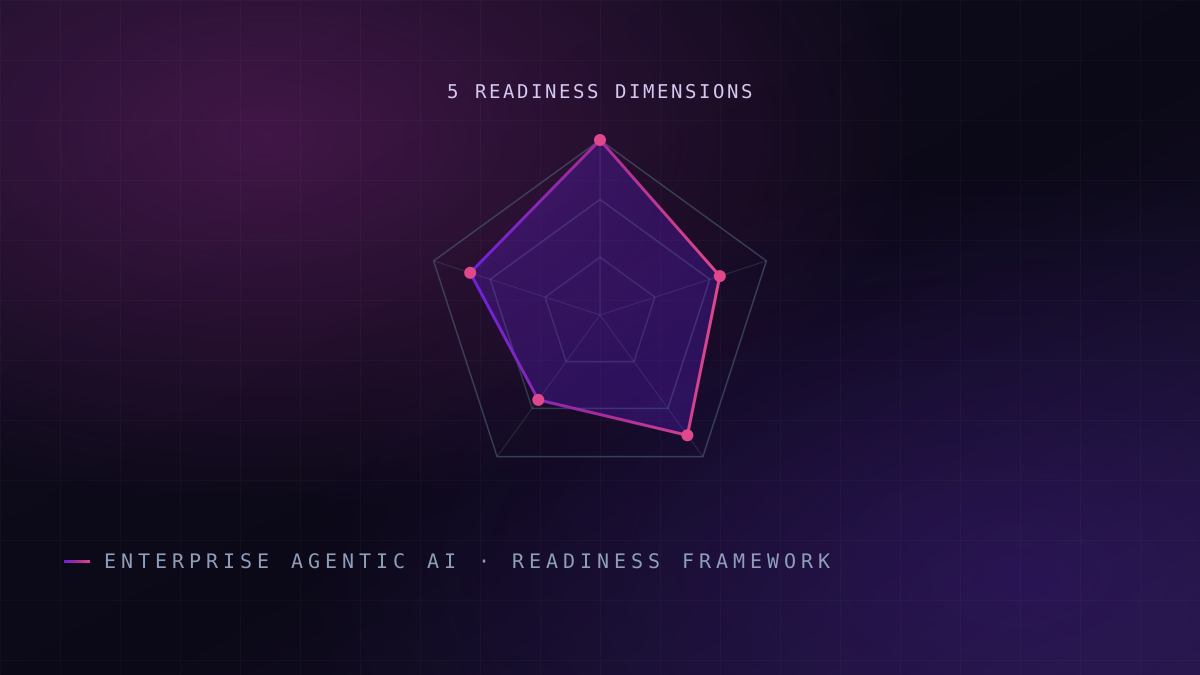
Agentic AI readiness is scored, not guessed. Five dimensions decide it: data foundation, orchestration and tooling, guardrails and governance, evaluation and observability, and operating model. Score them honestly and you learn three things — whether to adopt agents now, where to start, and what to fix first.
Why Readiness, Not Model Capability, Decides the Outcome
What this means for you: if you are choosing between vendors before you have scored yourself, you are optimising the wrong variable.
Agentic AI refers to systems in which a large language model plans and executes multi-step tasks by calling tools — querying data, invoking APIs, triggering workflows — rather than returning a single conversational response.
By 2026 the models are rarely the constraint. What separates enterprises with agents in production from those with abandoned pilots is the scaffolding around the model: governed data the agent can trust, contracts around the tools it can call, checkpoints where humans intervene, and an owner who is still there six months after launch.
Failure mode
The gap is rarely a model gap
Pilots that stall almost never fail on reasoning quality. They fail because nobody could say which number was correct, which action the agent was permitted to take, or who owned the system once the launch team moved on.
That scaffolding is assessable before you build anything, which is the point of this framework. Readiness is scored against an architecture, so if you have not yet settled what that architecture is, the four layers of an autonomous enterprise set out the sequence this assessment measures you against.
We use the framework at the front of agentic AI engagements and in standalone AI readiness assessments. The dimensions themselves are vendor-neutral: they apply whether you build on LangGraph, Azure AI Foundry, Bedrock Agents, or an in-house stack.
The Five Readiness Dimensions
What this means for you: score each dimension on a three-point scale. The lowest score is your critical path, and it decides the next quarter's roadmap.
1. Data Foundation
Agents act on what they can retrieve. If your estate is fragmented, undocumented, or semantically ambiguous, agents inherit that ambiguity and act on it at machine speed.
- Not ready. Critical entities — customer, product, contract — are defined differently across systems, lineage is absent, and retrieval means searching a file share.
- Ready. A governed lakehouse or warehouse with catalogued, access-controlled data, plus a semantic layer defining business entities and metrics.
- Leading. Machine-readable semantics — metric definitions, entity relationships, data contracts — that agents consume directly rather than infer.
The disciplines that get a domain from the first state to the second are covered in our guide to AI-ready data foundations; this framework assumes them rather than repeats them.
2. Orchestration and Tooling
An agent is only as safe and as useful as the tools it can call. Maturity here is about interfaces, not frameworks.
- Not ready. Business logic is locked in UIs and spreadsheets. There are no APIs, or APIs without documentation, idempotency, or stable authentication.
- Ready. The systems agents must touch expose versioned APIs with clear schemas, scoped credentials, and non-production environments to rehearse in.
- Leading. Explicit tool contracts — typed inputs and outputs, declared side effects, permission scopes — governed as artefacts, plus an orchestration layer that manages state, retries, and escalation.
3. Guardrails and Governance
Autonomy without policy is a liability generator. Readiness means knowing, before deployment, what an agent may do, what it may never do, and who answers when it errs.
- Not ready. No AI policy, or a policy written for chatbots that says nothing about actions. Approval paths are undefined.
- Ready. Action-level permissioning, personal-data handling rules, spend and blast-radius limits, and a named human owner for each agent's decisions.
- Leading. Policy enforced in the runtime rather than in documents, with every action evaluated against rules before execution and full decision traceability for audit.
Building the governing structure itself — roles, gates, and evidence — is a separate discipline, set out in our GenAI governance operating model. Turning the resulting rules into policy expressed as versioned code is a different job again.
4. Evaluation and Observability
You cannot operate what you cannot measure. Agent behaviour is probabilistic, so readiness here means treating evaluation as an engineering discipline rather than a demo review.
- Not ready. Quality is judged by stakeholders eyeballing outputs. There is no test set and no tracing.
- Ready. A curated evaluation suite of representative tasks with pass criteria, run before every change, plus traces of every step, tool call, and token spent.
- Leading. Continuous evaluation in production, regression gates in CI, drift alerts, and cost-per-task telemetry feeding back into design.
5. Operating Model
Agents are software with behaviour, and behaviour needs owners. The most common failure we see in our engagements is organisational rather than technical.
- Not ready. AI initiatives run as innovation-lab projects with no path to a product team, and success is measured in demos.
- Ready. A named product owner, an on-call path, defined service levels, and budget that survives the pilot.
- Leading. A platform team providing shared agent infrastructure — identity, guardrails, evaluation harnesses — so each new use case starts from a governed baseline.
Failure mode
The orphaned agent
A pilot team ships an agent, is redeployed, and nobody owns it when the upstream API changes three months later. The agent does not fail loudly. It degrades quietly, and trust in the whole programme goes with it.
Reading Your Scores
| Dimension | The question that scores it | If this is your lowest score, start here | Evidence the gap is closed |
|---|---|---|---|
| Data foundation | Can the agent retrieve a defined business entity, or must it infer one? | One domain: catalogue, access control, and semantic definitions for the entities that domain touches | Two teams querying the same measure get the same number, and the definition has an owner |
| Orchestration and tooling | Is every action the agent needs available as a documented, idempotent interface? | The two or three systems the first use case must write to | A retry after a timeout does not duplicate the effect of the original call |
| Guardrails and governance | Can you state, in writing, what this agent may never do? | An action-level permission model and a named decision owner | A reviewer can list the agent's permitted actions without reading its code |
| Evaluation and observability | Would you notice a 10% quality regression before a customer did? | A test set of representative tasks with pass criteria, run in CI | A change is blocked by an evaluation gate at least once, and the team accepts the block |
| Operating model | Who is paged when the agent misbehaves at 02:00? | A named product owner and a funded run budget beyond the pilot | The agent survives an upstream API change without an escalation to leadership |
The scores tell you whether to proceed. The next question is what to point an agent at.
Which Use Cases Actually Justify an Agent
What this means for you: most candidate use cases on your list are workflow problems wearing an AI costume. Four properties separate the real ones.
Agents earn their complexity where the path to the goal cannot be enumerated in advance. The strongest candidates share four marks.
Variable inputs, stable goal
Every case is different — an exception, an investigation, a reconciliation — but "done" is well defined and checkable.
Judgement across systems
The task requires reading context from several sources and deciding what to do next, rather than executing a fixed sequence.
Tolerable failure cost
A wrong step is recoverable, reviewable, or caught by a checkpoint before it becomes expensive.
Verifiable output
Success can be validated against a policy, a test, or a reference value without a human re-doing the work.
Exception handling in finance operations, multi-source research and synthesis, data quality investigation, and tiered support resolution all fit this profile. Note what the list rewards.
Bounded autonomy with verification — never open-ended autonomy.
The mirror image of that list is more useful still, and it is the part vendors leave out.
When Agents Are the Wrong Tool
What this means for you: if any of the five conditions below describes your candidate use case, an agent will cost more and prove less than the alternative.
A readiness framework that never says "no" is a sales document.
- The process is already deterministic. If the steps can be written as a flowchart, build the flowchart. An orchestrated pipeline is cheaper, faster, and inherently auditable, and replacing working automation with an agent adds latency and probabilistic failure for nothing.
- Errors are irreversible or regulated. Payments execution, clinical decisions, legal filings: where a single wrong action is unrecoverable, use a deterministic system with human sign-off, and let agents at most prepare work for approval.
- Latency budgets are tight. Multi-step reasoning loops cost seconds, not milliseconds. Real-time paths such as fraud scoring and dynamic pricing need models embedded in deterministic pipelines.
- Volume is high and variance is low. At millions of near-identical executions a day, per-task inference cost dominates. Agents suit the long tail of varied cases, not the head of repetitive ones.
- You cannot define success. If nobody can specify what a correct outcome looks like, you cannot evaluate the agent.
An unevaluatable agent is an unmanageable one.
| Dimension | Agentic automation | Deterministic workflow | What decides it |
|---|---|---|---|
| Risk profile | Probabilistic; needs guardrails, checkpoints, and rollback paths | Predictable; failure modes enumerable and testable in advance | Whether a wrong step is recoverable within the workflow |
| Latency | Seconds to minutes per task, driven by reasoning and tool loops | Milliseconds to seconds; suitable for real-time paths | Whether the consuming process can wait |
| Auditability | Requires deliberate tracing of plans, tool calls, and decisions | Inherent — every path is predefined and logged by design | Whether a regulator will ask why, not just what |
| Cost shape | Per-task inference cost; economical for varied, low-volume work | Near-zero marginal cost; economical at high volume | Where your volume sits on the head-versus-tail curve |
| Change handling | Adapts to input variance without code changes | Every new case requires explicit development | How often new case types appear |
| Best fit | Exceptions, investigations, synthesis, judgement across systems | Stable, high-volume, compliance-critical, latency-sensitive work | Whether the path to the goal can be enumerated in advance |
In practice
In practice: the answer is usually both
The mature pattern is rarely agent or workflow but a composition — deterministic workflows for the predictable spine, agents on the judgement-heavy branches, with explicit hand-offs between them.
Once the use case survives that test, the architecture it needs is remarkably consistent.
The Reference Architecture Readiness Converges On
What this means for you: four boundaries turn an agent from something that can do things into something whose capabilities are enumerable in an audit.
Readiness converges on a recognisable target: agents operating over governed data, through contracts, under supervision. Four boundaries define it.
A semantic boundary
Agents reason over defined business entities and metrics rather than guessing at table schemas. This is usually the highest-leverage prerequisite investment.
A retrieval boundary
Agents reach knowledge through a governed retrieval service that enforces access control and provenance, never through unmediated access to source systems.
Tool contracts
Every action is a typed, versioned, permission-scoped interface with declared side effects — the difference between capability and enumerable capability.
Human checkpoints
Approval sits where consequence exceeds demonstrated confidence, and the threshold moves with evidence from evaluation rather than with sentiment.
Semantic engineering is where most enterprises find the first boundary is missing, and it is rarely the one they expected to be blocked on.
Our UNO Orbit framework packages this structure — multi-agent design, orchestration, and human-governed policy enforcement — but the architecture stands independent of any product. For the implementation depth behind it, including supervisor patterns and validation agents, see our companion piece on designing production agentic AI systems. This article stays deliberately at the adoption-decision altitude.
How to Sequence the First Year
What this means for you: the sequence below assumes you scored "not ready" somewhere. Almost everyone does, and it is not a reason to wait.
Assess before you build
Score the five dimensions honestly. The lowest score sets your critical path, and in our engagements it is usually data foundation or operating model rather than tooling.
Fix one domain, not the estate
Bring a single high-value domain to "ready" — governed data, semantic definitions, tool contracts for the two or three systems that matter.
Ship one supervised agent
Pick a use case that passes the four marks, run it with tight checkpoints, and invest as much in the evaluation suite as in the agent itself.
Widen autonomy with evidence
Relax checkpoints only where evaluation data justifies it, then extract identity, guardrails, tracing and evaluation into a shared platform capability.
Readiness signal
You are ready to start when
You can name the domain, the owner, the first use case, and the evaluation set — before anyone has chosen a framework. If the framework decision came first, the assessment has not happened yet.
A modest agent with rigorous evaluation teaches more than an ambitious demo. That is the whole argument for scoring yourself first.
Frequently Asked Questions
What is agentic AI readiness?
Agentic AI readiness is an organisation's fitness to deploy AI systems that take autonomous, tool-using actions. It is measured across five dimensions: data foundation, orchestration and tooling, guardrails and governance, evaluation and observability, and operating model. The assessment is possible before any build, and its result determines whether to adopt agents now, where to start, and what to fix first.
How is agentic AI different from RPA or workflow automation?
Robotic process automation and workflow engines execute predefined steps deterministically. Agentic AI plans its own steps toward a goal and adapts to variable inputs. That flexibility costs you probabilistic behaviour, higher latency, and per-task inference charges, which is why deterministic automation remains the correct tool for stable, high-volume, latency-sensitive, or irreversible processes. Most mature designs combine both rather than choosing one.
Do we need a lakehouse before deploying agents?
You need governed, semantically defined data for the domain the agent operates in. A lakehouse is the common way to get there, not the requirement itself. What matters is that the agent retrieves through access-controlled, documented interfaces rather than raw system access, and that the key business entities in that domain have single, machine-readable definitions with named owners.
Where should human-in-the-loop checkpoints go?
Wherever the consequence of an action exceeds the demonstrated confidence of the agent: irreversible operations, external communications, financial commitments, and policy-sensitive decisions. Checkpoints should be adaptive rather than fixed — tightened at launch, then relaxed selectively as evaluation evidence accumulates. Set the threshold from measured performance on a representative test set, not from how the demo felt.
What does "not ready" mean — should we wait?
No. "Not ready" means your first investment should be foundational rather than an agent build: semantic definitions, tool contracts, and evaluation practice, scoped to one domain. In our engagements, teams that spend a quarter closing readiness gaps in a single domain tend to overtake those that spent the same quarter on an ungoverned pilot.
Unolabs is a Data and AI first engineering consultancy, headquartered in the United Kingdom with engineering operations in Pune and active engagements across the UK, Australia, and Hong Kong. We help enterprises build the architectural foundation for autonomous AI execution — governed data platforms, semantic intelligence, and agentic systems that enterprises can stand behind.
If you are weighing whether your organisation is ready for agentic AI, or which readiness gap to close before the others, book a discovery call and we will score it with you.
More Where
This Came From.
New architectural deep-dives land every two weeks. Pick your channels and we will send them as they publish.
Continue reading
- AI Readiness & StrategyThe AI Problem Nobody Talks About: It's the Data, Not the ModelEnterprise AI fails on ungoverned data, not model choice. How to sequence the data foundation before the AI layer, and three cases where you should not.13 min read
- Agentic ArchitecturesDesigning Production Agentic AI Systems: Architecture Patterns, Guardrails, and EvaluationHow production agentic AI is built: the agent loop, typed tool contracts, guardrail config, evaluation harnesses, and the gates that grant autonomy safely.15 min read
- Data Engineering Trends 2026AI-Powered Autonomous Data Operations: What to Automate, and What to Keep Under ReviewAutonomous data operations explained: six AI DataOps capabilities, five levels of autonomy, and the guardrails that decide what may run without a human.13 min read
Score your agentic AI readiness before you build
We will run the five-dimension assessment with your data, platform and risk leads and tell you which dimension would stop an agent reaching production.
Book a Readiness Assessment