Data Platform Strategy
What Is a Semantic Layer, and When Does an Enterprise Need One?
What a semantic layer is, how it differs from a BI model or catalogue, the four artefacts it must hold, and when an enterprise needs one for BI and AI.
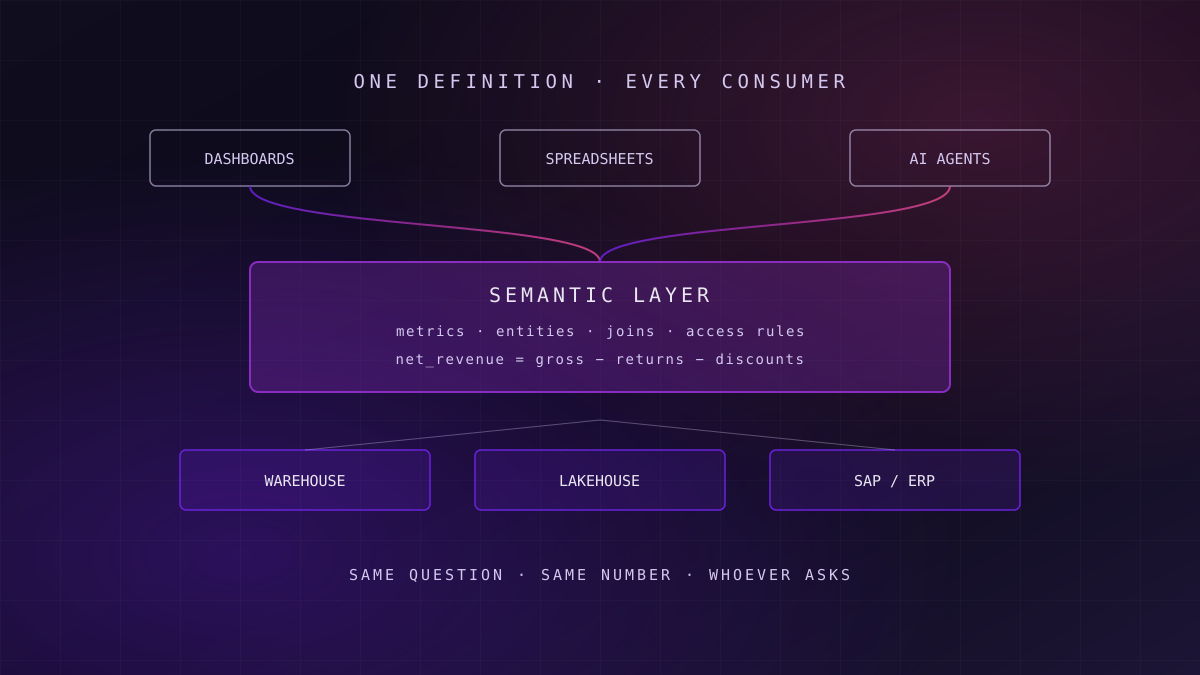
A semantic layer is a governed set of business definitions — metrics, entities, joins and access rules — between raw data and every tool that queries it, so the same question returns the same number in a dashboard, a spreadsheet or an AI agent. An enterprise needs one when several tools or teams compute the same core metrics independently.
The idea is decades old; SAP BusinessObjects universes and OLAP cubes did a version of it in the 1990s. What changed is the number of consumers. A modern estate serves several BI tools, notebooks, embedded analytics and, increasingly, language-model agents that write their own queries. Each of those consumers will reinvent "revenue" unless something stops it.
Why Semantic Layers Are Back on the Agenda
What this means for you: if AI pilots are producing numbers finance does not recognise, the problem is usually missing definitions, not a weak model.
Three developments put the semantic layer back on architecture roadmaps. First, BI tool sprawl: most large organisations run more than one BI tool, and each holds its own model of the business. Second, the major vendors have rebuilt their products around the term. Microsoft renamed Power BI datasets to "semantic models" in November 2023, and SAP Datasphere's analytic models play the same role for SAP data.
Third, and most important, generative AI. A language model asked "what was net revenue in Q3?" will write plausible SQL against whatever tables it can see. Without governed definitions it has no way to know that net revenue excludes intercompany sales, or that returns are booked a month late. Our account of why enterprise AI stalls on data rather than models traces this failure in detail.
An agent with database access and no semantic layer is a confident analyst who has never met your finance team.
The industry has noticed. On 23 September 2025 Snowflake announced the Open Semantic Interchange, an initiative with Salesforce, dbt Labs, BlackRock, RelationalAI and others to create a vendor-neutral specification for semantic metadata. At its Coalesce 2025 conference, dbt Labs moved MetricFlow, the engine behind the dbt Semantic Layer, to the Apache 2.0 licence and positioned it as a reference implementation for that specification.
What a Semantic Layer Actually Is
What this means for you: a precise definition stops you buying a dashboard tool, a data catalogue or a knowledge graph and calling it a semantic layer.
A semantic layer is a machine-readable model of the business that translates business questions into correct queries. It holds definitions, not data. It is consumed through an interface — SQL, an API, or a tool connector — so that each consumer asks for "net revenue by region" and receives the governed answer, rather than writing its own calculation.
It is easy to confuse with three neighbours. A BI model, such as a Power BI semantic model or a LookML project in Looker, is a semantic layer scoped to one tool; it works well until a second tool needs the same definitions. A data catalogue describes what data exists and who owns it, but does not compute anything. A knowledge graph models entities and relationships richly, and can underpin a semantic layer, but is not by itself a metric engine.
Metric definitions
Each measure defined once, with its formula, grain, filters and time logic: net revenue, active customer, gross margin.
Entities and joins
Customers, products and orders, with the approved join paths between them, so no consumer invents a many-to-many join that doubles revenue.
Access rules
Row- and column-level security applied once, at the layer, so every consumer inherits the same restrictions.
Ownership and lineage
A named owner for every definition, plus lineage back to source tables, so a disputed number can be traced and settled.
If any of those four is missing, the layer will not hold. Definitions without ownership drift. Joins without governance double-count. Access rules applied tool by tool leak.
Where the Semantic Layer Can Live
What this means for you: the right home for definitions depends on how many consumers you have and how many platforms they span.
There are four broad places to put it, and each comes with a trade-off you should accept knowingly rather than discover later.
| Approach | Examples | Strength | Choose this when |
|---|---|---|---|
| Inside the BI tool | Power BI semantic models, Looker LookML, Tableau published data sources | Fast to build, tight tool integration | One BI tool serves most users and will for years |
| Transformation-layer metrics | dbt Semantic Layer with MetricFlow | Definitions versioned in code beside the pipelines | Analytics engineers own modelling and several tools consume |
| Universal semantic layer | Cube, AtScale | Serves many tools and APIs from one model | Three or more consumers, including applications and agents |
| Platform-native | SAP Datasphere analytic models, Snowflake semantic views, Databricks metric views | Close to the data, inherits platform security | Most data and consumers sit on one platform |
The BI-tool option is the commonest and the most often outgrown. It becomes a problem the day a second tool arrives, or an AI assistant needs the same definitions outside the BI tool. Transformation-layer metrics suit teams already working in dbt, because definitions are reviewed and tested like any other code.
In practice
In practice: platform-native features change quickly
Snowflake, Databricks and SAP have all extended their native semantic features since 2024. Check current capabilities and connector support at evaluation time rather than relying on last year's comparison.
Universal layers carry an extra component to operate, but earn it when consumers multiply. Platform-native options are attractive where one platform dominates, and our guide to choosing between Snowflake and Databricks covers the platform decision that usually precedes this one.
The Semantic Layer and Enterprise AI
What this means for you: if you plan to let AI answer questions about the business, the semantic layer is the control that keeps those answers consistent with your published numbers.
Generative AI changes the economics of the semantic layer. Before, inconsistent definitions produced arguments in meetings. Now they produce wrong answers at scale, delivered fluently, to people who will not check the SQL. A semantic layer gives an AI system a constrained vocabulary: instead of writing free-form SQL against hundreds of tables, the model chooses from governed metrics and dimensions.
That narrowing matters for accuracy and for audit. When a model queries "net revenue by region" through the layer, the formula, filters and access rules are the ones finance approved, and the query can be logged and reproduced. When it writes raw SQL, every answer is a fresh, unreviewed interpretation.
Key idea
Definitions are the guardrail AI teams forget
Prompt engineering and retrieval tuning cannot fix a metric that has two definitions. Agree the definition first, publish it through the semantic layer, then let the model consume it.
The same applies to retrieval-augmented generation over structured data and to agentic AI systems that act on business figures. An agent that triggers a reorder because stock "fell below threshold" needs to share the warehouse team's definition of stock. Work on semantic AI and knowledge models usually starts here: with metric and entity definitions agreed by the people accountable for them.
How to Tell Whether You Need One Now
What this means for you: a few concrete tests show whether a semantic layer will pay back this year or is premature.
You probably need a semantic layer now if two or more of these are true. Two teams present different figures for the same metric to the same committee. More than one BI tool, or a BI tool plus notebooks and spreadsheets, computes core metrics. An AI assistant or agent is being piloted against business data. Analysts spend recurring time reconciling numbers rather than explaining them.
Readiness signal
Readiness signal: can you name the owner of net revenue?
Pick your three most-quoted metrics. If you cannot name one accountable owner and one written definition for each, start with that agreement. Software will not settle it for you.
You probably do not need one yet if a single BI tool serves nearly everyone, metric disputes are rare, and no AI pilots touch business figures. In that case the BI tool's own model is the semantic layer, and the sensible step is to keep its definitions documented and owned. Getting enterprise data architecture right before adding components saves more than adding them early.
When a Semantic Layer Is the Wrong Investment
What this means for you: a semantic layer built in the wrong conditions becomes one more place where definitions disagree.
A semantic layer cannot resolve a political disagreement. If sales and finance define "booking" differently because their incentives differ, encoding one definition in software creates a loser who will route around it. The agreement has to come first, sponsored by someone with authority over both.
Failure mode
Failure mode: the semantic layer nobody uses
A universal layer deployed while every BI tool keeps its own calculations simply adds a third definition. Unless existing reports are migrated to consume the layer, it becomes shelfware with a licence fee.
It is also the wrong investment for small estates, for exploratory data science where definitions are meant to change weekly, and where source data quality is too poor for any definition to produce a trustworthy number. In that last case the work belongs upstream, in pipelines, data contracts and quality checks such as those described in governance enforced in CI/CD.
Software can publish a definition everyone has agreed. It cannot manufacture the agreement.
Finally, be cautious of designing for a standard that is still forming. The Open Semantic Interchange is promising, but in 2026 it is an emerging specification, not a settled one. Choose tools that export definitions in open, version-controlled formats, so that a later move costs a migration, not a rewrite.
How to Build One Without a Big-Bang Programme
What this means for you: start with the metrics that cause the most arguments, and let adoption, not coverage, measure progress.
Begin with an inventory. List the twenty most-used metrics and record every place each one is calculated: BI tools, spreadsheets, SQL views, application code, AI pilots. The divergences you find are the business case. In our engagements, the first useful result is usually that inventory alone, because it shows leaders where their numbers come from.
Then agree and publish a small set. Choose five to ten metrics with named owners, write their definitions, encode them in the chosen layer, and migrate the most visible reports to consume them. Measure success by how many reports and AI queries use the governed definitions, not by how many metrics exist.
Scope matters for timelines. A first wave of a handful of governed metrics, consumed by one BI tool and one AI pilot, typically moves in weeks rather than quarters. Extending it to every domain is multi-quarter work that follows the organisation's ownership model, which is why the mesh or fabric choice in data mesh versus data fabric shapes it. Where SAP is the main source, the layer often sits in Datasphere, a decision covered in our SAP BW to Datasphere migration guide.
Readiness signal
Readiness signal: governed queries are rising
Track the share of dashboard and AI queries that resolve through the semantic layer each month. If it is flat after the first wave, adoption has stalled and more metrics will not fix it.
Throughout, keep the layer close to the people who consume it. Analytics and BI delivery teams should treat governed metrics as the default source, and reserve ad hoc calculation for genuinely exploratory work.
Running the Semantic Layer After Go-Live
What this means for you: a semantic layer is a product with users and releases, and it decays quickly if it is treated as a one-off build.
Definitions change. A new pricing model alters how revenue is recognised, an acquisition adds a second customer master, a regulator redefines a reportable measure. Each change needs an owner to approve it, a version to record it, and a way to tell consumers what moved. Without that, the layer either freezes and becomes wrong, or changes silently and breaks trust.
The practical answer is to manage definitions the way engineering teams manage code. Store them in version control, review changes through pull requests that the metric owner approves, test them against known results before release, and publish a change log that analysts and AI teams can read. Where definitions sit in a vendor tool without good export, schedule a regular extract so the history is not trapped in one product.
| Operating question | Weak answer | Strong answer | What it protects |
|---|---|---|---|
| Who can change a metric? | Anyone with tool access | The named owner approves every change | Trust in published figures |
| How is a change recorded? | It is not | Versioned definition with a dated change log | Audit and reproducibility |
| How are consumers told? | They notice the number moved | Release notes before the change goes live | Board packs and AI answers |
| How is a change tested? | In production | Against reference results before release | Reports that silently break |
Two further habits help. First, retire definitions deliberately: a deprecated metric should stay queryable for a stated period, with a warning, before it is removed. Second, review usage quarterly. Metrics nobody queries add maintenance and confuse AI systems choosing between near-duplicates, so prune them.
Frequently Asked Questions
What is a semantic layer in simple terms?
A semantic layer is a shared, governed set of business definitions, such as how net revenue or an active customer is calculated, that sits between raw data and the tools people use. Dashboards, spreadsheets and AI assistants query the layer instead of writing their own calculations, so the same question returns the same number wherever it is asked and whoever asks it.
Is a Power BI semantic model a semantic layer?
Yes, but one scoped to Power BI. Microsoft renamed Power BI datasets to semantic models in November 2023, and they hold measures, relationships and security for Power BI reports. They work well when Power BI is the main consumer. When other BI tools, applications or AI agents need the same definitions, an enterprise usually needs a layer that serves more than one tool.
Why does AI need a semantic layer?
A language model asked a business question will write its own query against whatever tables it can see, and has no way to know the approved definition of a metric. A semantic layer restricts it to governed metrics, dimensions and access rules, so its answers match published figures and each query can be logged and reproduced for audit.
What is the Open Semantic Interchange?
The Open Semantic Interchange is an initiative announced by Snowflake on 23 September 2025 with partners including Salesforce, dbt Labs, BlackRock and RelationalAI. Its aim is a vendor-neutral specification for semantic metadata, so metric and entity definitions can move between BI tools, platforms and AI systems. In 2026 it remains an emerging specification rather than a settled standard.
How long does it take to build a semantic layer?
A first wave of five to ten governed metrics, with named owners and consumed by one BI tool and one AI pilot, typically takes weeks rather than quarters. Covering every business domain is multi-quarter work, paced by how quickly owners agree definitions and existing reports are migrated to use the layer instead of their own calculations.
Unolabs is a Data and AI first engineering consultancy, headquartered in the United Kingdom with engineering operations in Pune and active engagements across the UK, Australia, and Hong Kong. We help enterprises build the architectural foundation for autonomous AI execution — governed data platforms, semantic intelligence, and agentic systems that enterprises can stand behind.
If you are weighing where your metric definitions should live, or whether you need a semantic layer before scaling AI, book a discovery call and we will work through it with you.
More Where
This Came From.
New architectural deep-dives land every two weeks. Pick your channels and we will send them as they publish.
Continue reading
- Data Platform StrategyBig Data Analytics in Retail: The Five Use Cases That Pay Back, and What Each One Needs FirstBig data analytics in retail pays back in five places. What each use case needs, where it stops paying off, and the platform UK retailers build first.14 min read
- Data Platform StrategyHow to Choose a Data and AI Consultancy: A Buyer's ChecklistA vendor-neutral checklist for choosing a data and AI consultancy: the questions to ask, the evidence to demand, the red flags, and how to test the exit.13 min read
- Data Platform StrategyReference Architectures and Industry Data Templates: When a Head Start Pays Off, and When It Costs YouWhen an industry data template or reference architecture speeds a data platform, when it slows one down, and how to decide before the build starts.13 min read
Find out which of your metrics have two definitions
We will trace your ten most-used metrics across BI tools, spreadsheets and AI pilots, show where definitions diverge, and tell you where a semantic layer should live.
Book a Metric Definition Audit